
For thousands of Indian students dreaming of becoming doctors, cost is often the biggest hurdle. Private medical colleges in India charge lakhs, sometimes crores, for a single MBBS seat, while government seats remain extremely limited. This is why MBBS in Russia has become such a popular alternative. Affordable tuition, quality education, and globally recognized degrees make it an attractive option for Indian families. At Easylearn Educare, we regularly guide students through the entire process, right from choosing a university to understanding the complete cost breakdown. In this blog, we’ll break down everything you need to know about MBBS fees in Russia, so you can plan your budget with confidence. Why Are MBBS Fees in Russia So Affordable? Russian medical universities are largely government-funded, which keeps tuition costs significantly lower than private institutions in India or other study-abroad destinations like the USA or UK. Additionally, there’s no donation or capitation fee involved, unlike many private colleges back home. Admission is purely merit-based through NEET qualification, which removes hidden costs that often inflate the total expense of medical education elsewhere. Average Tuition Fees On average, tuition fees for Russian medical universities range between ₹2.5 lakh and ₹6 lakh per year, depending on the university’s location and reputation. Moscow-based universities tend to be on the higher end due to their global rankings and infrastructure, while universities in cities like Volgograd, Perm, or Bashkir are more budget-friendly. Over a full six-year program, total tuition typically ranges from ₹25 lakh to ₹40 lakh, which is still considerably lower than most private Indian medical colleges. Understanding the MBBS in Russia Fee Structure The MBBS in Russia fee structure usually includes tuition fees, hostel charges, and sometimes a one-time admission or registration fee. Tuition is generally paid annually or semester-wise, directly to the university. Hostel fees are separate and typically range from ₹20,000 to ₹70,000 per year, depending on the city and type of accommodation. It’s important to ask for a detailed fee breakdown before finalizing your university, as some institutions bundle in extra charges like medical insurance, visa support, or student welfare fees. Other Expenses to Consider Beyond tuition and hostel costs, students should budget for food, local transport, study materials, and health insurance. Living expenses in Russia are relatively affordable compared to Western countries, with many students managing comfortably on a modest monthly budget. It’s also wise to set aside funds for a return trip home during breaks and for FMGE/NExT exam preparation closer to graduation. Scholarships That Can Reduce Your Costs Many students aren’t aware that a scholarship for MBBS in Russia is available at several universities, based on merit or financial need. These scholarships can reduce annual tuition by 10% to 25%, making an already affordable option even more accessible. Eligibility criteria vary by university, so it’s worth checking with your consultant early in the admission process to see which scholarships you may qualify for. How to Plan Your Budget Effectively Before applying, create a rough estimate of your total six-year expenditure, including tuition, hostel, food, and miscellaneous costs. Compare this with the cost of a private medical seat in India, and you’ll likely see substantial savings even after factoring in travel and living expenses. Choosing a university with a straightforward fee structure and transparent billing also helps avoid unexpected costs later. How Easylearn Educare Can Help Understanding fee structures, currency exchange rates, and payment schedules can be confusing without proper guidance. That’s where Easylearn Educare steps in. We help students compare universities based on genuine, updated fee data, so there are no surprises after enrollment. Our team also assists with documentation, scholarship applications, and visa formalities to make the entire journey smooth. If you want a clear picture of the total costs involved, get free counselling from our team and get answers to all your fee-related queries. We also invite students and parents to visit our office to go through university-wise fee comparisons in person. For the best education consultation for MBBS admission, connect with us today and take a well-informed step toward your medical career in Russia. Frequently Asked Questions 1. What is the average yearly tuition fee for MBBS in Russia? Tuition fees generally range between ₹2.5 lakh and ₹6 lakh per year, depending on the university and city, making it far more affordable than private colleges in India. 2. Are hostel fees included in the tuition fee? No, hostel fees are usually charged separately and range from ₹20,000 to ₹70,000 annually, depending on the type of accommodation and university location. 3. Is there any hidden cost involved in Russian MBBS admissions? Reputed universities have transparent fee structures with no hidden costs. However, students should always request a detailed fee breakdown before confirming admission. 4. Do Russian universities offer scholarships to Indian students? Yes, several universities provide merit-based or need-based scholarships, which can reduce annual tuition fees significantly for eligible international students. 5. How much should I budget for living expenses in Russia? Living expenses, including food and local transport, are relatively low. Most students manage comfortably within a modest monthly budget alongside tuition costs. 6. Can fees increase during the course duration? Some universities may revise fees slightly over the years due to inflation or currency fluctuation, so it’s advisable to confirm this before enrollment. 7. Is the total cost of MBBS in Russia lower than private Indian colleges? Yes, the total six-year cost, including tuition and hostel, is usually much lower than private medical colleges in India, which often charge ₹50 lakh or more.
Author Archives: eladmin
Top 10 Medical Colleges in Russia for Indian Students
Every year, thousands of Indian students choose Russia to pursue their dream of becoming a doctor. With affordable tuition, globally recognized degrees, and NMC-approved universities, Russia has become one of the most trusted destinations for MBBS abroad. At Easylearn Educare, we help students navigate the entire admission process, from choosing the right university to settling into campus life. If you’re planning to study medicine overseas, here’s a look at the top ten medical colleges in Russia for Indian students, along with everything you need to know before applying. Why Choose Russia for MBBS? Russian medical universities are recognized by the WHO, NMC, and UNESCO, making them a safe and reliable choice for Indian students. Most colleges offer English-medium teaching, so there’s no need for Russian language proficiency to begin your course. Admission is based purely on your NEET score, without the need for donations or capitation fees that are common in many private Indian colleges. Top 10 Medical Colleges in Russia I.M. Sechenov First Moscow State Medical University – One of the oldest and most prestigious medical schools in Russia, known for strong clinical training. Kazan State Medical University – A globally ranked institution with modern labs and a large international student community. Lomonosov Moscow State University – Offers a strong academic reputation and access to advanced research facilities. Volgograd State Medical University – Popular among Indian students for its affordable fee structure and supportive faculty. Siberian State Medical University – Established in 1878, it’s among Russia’s oldest medical institutions with a large foreign student base. Orel State Medical University – Known for English-medium programs and a welcoming environment for international students. Perm State Medical University – A safe, interior-city option with consistent NMC recognition. Bashkir State Medical University – One of the most budget-friendly options for a full 6-year MBBS program. Chuvash State Medical University – Offers modern infrastructure and strong practical exposure in teaching hospitals. Tver State Medical University – Well-regarded for its academic discipline and research opportunities. Each of these universities is considered a best medical college in Russia, offering solid infrastructure, experienced faculty, and hands-on clinical exposure through affiliated teaching hospitals. Understanding the Costs One of the biggest reasons Indian families choose Russia is affordability. On average, medical college fees in Russia range from ₹2.5 lakh to ₹6 lakh per year, depending on the university and city. This is significantly lower than private medical colleges in India, where total costs can reach ₹50 lakh to ₹1 crore. Living expenses, including food and transport, are also budget-friendly compared to other international destinations. Accommodation and Campus Life Most universities provide on-campus accommodation designed for international students. The Russia medical college hostel facilities typically include furnished rooms, common kitchens, Wi-Fi, and 24/7 security. Many hostels also have separate floors for Indian students, making it easier to find familiar food and a supportive community while adjusting to life abroad. Admission Process Applying to a Russian medical college for MBBS is straightforward. Students need a valid NEET qualifying score, along with academic transcripts from Class 10 and 12. There’s no entrance exam conducted by the universities themselves, and admissions typically open twice a year, in September and February intake sessions. After completing the 6-year program (including a compulsory internship), graduates must clear the FMGE or NExT exam to practice medicine in India. How Easylearn Educare Can Help Choosing the right university, understanding visa requirements, and preparing documentation can feel overwhelming. That’s where Easylearn Educare comes in. Our team works closely with students and parents to shortlist universities that align with academic goals and budgets, while ensuring every institution is properly NMC-approved and WDOMS-listed. If you’d like personalised guidance, get free counselling from our experienced advisors before making your final decision. We also recommend that families visit our office to discuss documentation, scholarships, and university-specific requirements in detail. Studying MBBS abroad is a major decision, and having the right guidance can make all the difference. For the best education consultation for MBBS admission, connect with our team today and take the first step toward your medical career in Russia. Frequently Asked Questions 1. Is a Russian MBBS degree valid in India? Yes, degrees from NMC-approved Russian universities are valid in India. Graduates must clear the FMGE or NExT exam to practice medicine within the country. 2. Do I need to know Russian to study MBBS there? No, most universities teach MBBS entirely in English. However, learning basic Russian helps during hospital rounds and daily interactions with patients. 3. What is the minimum NEET score required? There’s no fixed minimum score, but students must have a qualifying NEET result along with Physics, Chemistry, and Biology in Class 12. 4. How long does the MBBS course take in Russia? The course duration is six years, including five years of academic study and a mandatory one-year clinical internship before graduation. 5. Are hostel facilities safe for Indian students? Yes, university hostels have security, Wi-Fi, and basic amenities. Many campuses also house large Indian student communities for added comfort. 6. Can I get a scholarship for MBBS in Russia? Some universities offer merit-based or need-based scholarships to eligible international students, which can reduce yearly tuition costs significantly. 7. What documents are required for admission? Students need a valid passport, NEET scorecard, Class 10 and 12 marksheets, passport-size photos, and a medical fitness certificate for enrollment.
7 Best Medical Colleges in Tamil Nadu for MBBS (2026 Guide)
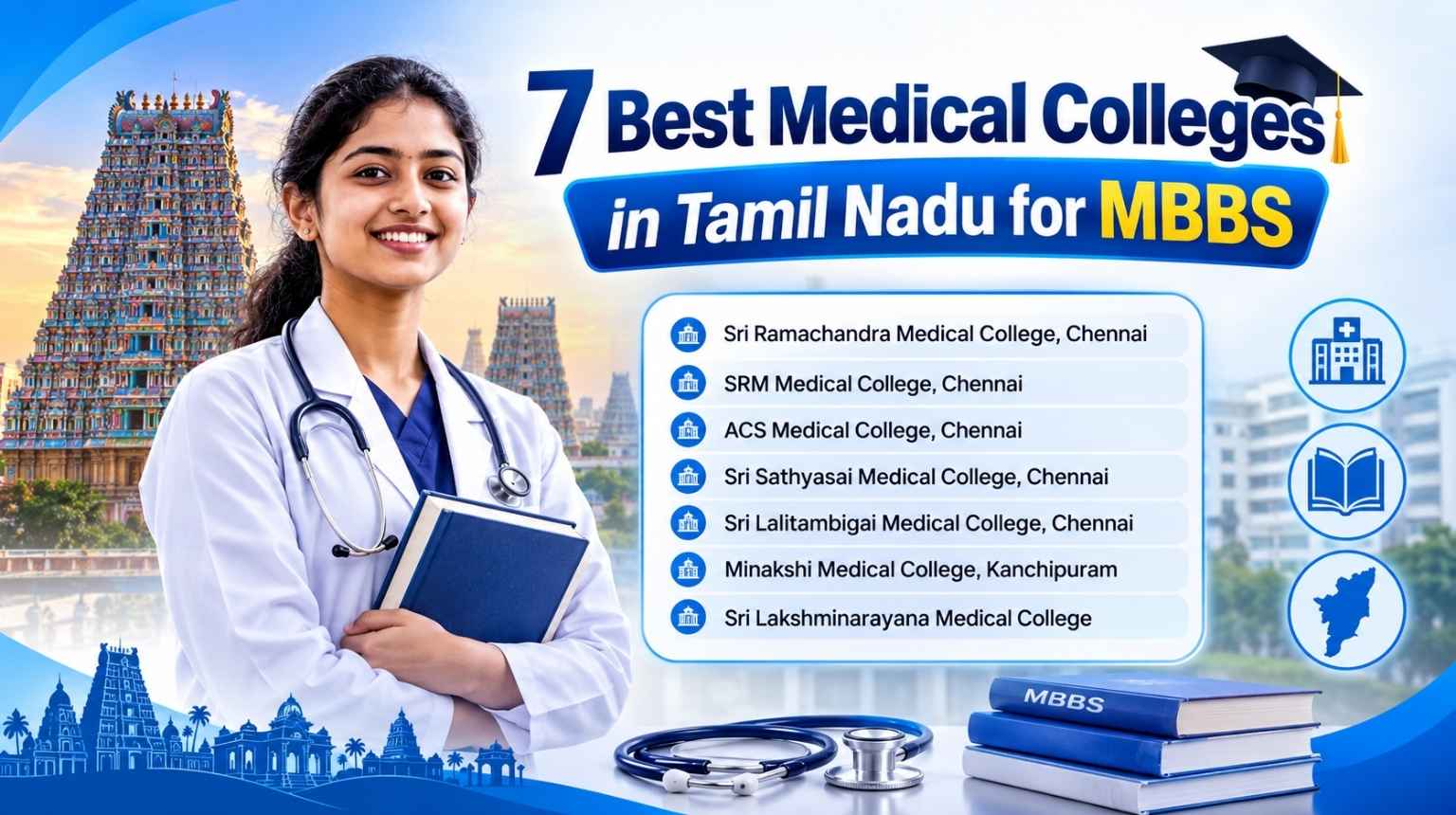
Choosing the right medical college is one of the most important decisions in a student’s journey toward becoming a doctor. Tamil Nadu, with its strong healthcare infrastructure and academic ecosystem, offers some of India’s finest private and deemed medical institutions for MBBS. In this blog, we highlight top private medical colleges in Tamil Nadu known for quality education, clinical exposure, and modern facilities. List Of Private Medical Colleges In Tamilnadu 1. Sri Ramachandra Medical College, Chennai Sri Ramachandra Medical College (SRMC), part of Sri Ramachandra Institute of Higher Education and Research (Deemed University), is one of India’s most respected medical institutions. It offers 250 MBBS seats with a strong emphasis on clinical training, research, and community health. Affiliation: Deemed University (SRMIST) Hospital: Multi-specialty teaching hospital with advanced diagnostics and ICUs Fees: Approximately ₹30 lakh per year (management/NRI quotas available) Highlights: NAAC-accredited, strong research output, global collaborations, and extensive patient exposure SRMC is ideal for students aiming for a comprehensive medical education with opportunities for postgraduate specialization and international exposure. 2. SRM Medical College Hospital and Research Centre, Chennai SRM Medical College, located in Kattankulathur (Chennai), is part of SRM Institute of Science and Technology (Deemed University). It offers 250 MBBS seats and is recognized for its modern infrastructure, experienced faculty, and strong clinical training. Affiliation: SRM Institute of Science and Technology (Deemed University) Hospital: 1,500+ bed multi-specialty hospital Fees: Around ₹25 lakh per year Highlights: Strong focus on research, innovation, and patient care; ample clinical exposure SRM Medical College is a preferred choice for students seeking a blend of academic excellence and hands-on clinical experience. 3. ACS Medical College, Chennai ACS Medical College and Hospital, part of Dr. M.G.R. Educational and Research Institute (Deemed University), is a well-established institution offering 150 MBBS seats. Affiliation: Dr. M.G.R. Educational and Research Institute (Deemed University) Hospital: 1,050-bed multi-specialty hospital Fees: Approximately ₹23–25 lakh per year Highlights: NMC-recognized, transparent admission via MCC, strong clinical training, and no capitation fees ACS Medical College is known for its structured curriculum, modern labs, and supportive faculty, making it a solid option for MBBS aspirants. 4. Sri Sathya Sai Medical College and Research Institute, Chennai Located in Ammapettai (Chengalpattu), Sri Sathya Sai Medical College and Research Institute (SSSMCRI) is a constituent unit of Sri Balaji Vidyapeeth (Deemed University), Puducherry. Affiliation: Sri Balaji Vidyapeeth (Deemed University) Hospital: 700–890 bed multi-specialty teaching hospital Fees: Around ₹20 lakh per year (total ~₹1 crore for 5 years) Highlights: NAAC A++ accredited, strong clinical exposure, research-focused curriculum, and green campus SSSMCRI is ideal for students seeking a serene campus environment with quality education and robust hospital training. 5. Sri Lalithambigai Medical College and Hospital, Chennai Sri Lalithambigai Medical College and Hospital (SLMCH), a unit of Dr. M.G.R. Educational and Research Institute, is a newer but rapidly growing institution in Chennai. Affiliation: Dr. M.G.R. Educational and Research Institute (Deemed University) Hospital: 940-bed multi-specialty hospital with 24×7 services Fees: Approximately ₹19–21 lakh per year Highlights: Modern infrastructure, digital labs, central research lab, and MCC-based admissions SLMCH is a great choice for students looking for a modern campus with strong hospital exposure and transparent admission processes. 6. Meenakshi Medical College Hospital and Research Institute, Kanchipuram Meenakshi Medical College Hospital and Research Institute (MMCHRI), part of Meenakshi Academy of Higher Education and Research (MAHER), is located in Enathur, Kanchipuram. Affiliation: Meenakshi Academy of Higher Education and Research (Deemed University) Hospital: Tertiary care teaching hospital with advanced diagnostics and ICUs Fees: Competitive fee structure with NRI and management quotas Highlights: 250 MBBS seats, strong PG and super-specialty programs, and robust clinical training MMCHRI is well-regarded for its comprehensive medical programs and strong hospital infrastructure. 7. Sri Lakshminarayana Medical College, Chennai Sri Lakshminarayana Institute of Medical Sciences (often referred to as Sri Lakshminarayana Medical College) is a reputed private medical college offering quality MBBS education. Affiliation: Tamil Nadu Dr. MGR Medical University (Private) Hospital: Attached teaching hospital with multi-specialty services Fees: Competitive fee structure with transparent admission Highlights: Strong clinical exposure, experienced faculty, and focus on holistic development This college is a solid option for students seeking affordable yet quality medical education in Tamil Nadu. Also Check: Medical Colleges in West Bengal NEET UG Cut-Off Trends (Expected Safe Scores) Getting admission to a private medical college in Tamil Nadu depends on several factors, including your NEET UG score, category, seat availability, reservation policies, and counselling rounds. While the official cut-off changes every year, previous counselling data provides a useful estimate for students planning their MBBS admission. Note: The scores below are expected safe score ranges based on previous years’ Tamil Nadu medical counselling trends. These are meant only for guidance and should not be considered official cut-offs. The final closing ranks and cut-off scores are released during the Tamil Nadu Medical Selection Committee counselling for the respective academic session. Quota Category General / Open Safe Score (Approx.) Reserved / Minority Safe Score (Approx.) Other State (Management Quota) Government / State Quota in Top Private Medical Colleges 540 – 580+ 450 – 520+ Not Eligible Government / State Quota in Other Private Medical Colleges 480 – 520+ 380 – 440+ Not Eligible Management Quota (Open to All India) 430 – 480+ 430+ 430 – 480+ Minority Quota Seats Not Applicable 300 – 400+* Subject to Minority Eligibility *Candidates applying under the Minority Quota must possess a valid minority certificate as required by the counselling authority. How to Secure Admission? Admission to MBBS programs in Tamil Nadu’s private and deemed colleges is through NEET-UG followed by MCC (Medical Counselling Committee) counselling for deemed universities and state counselling for private colleges. Students must meet eligibility criteria (10+2 with PCB, minimum 50% marks, and qualifying NEET-UG).slmch+3 For personalized guidance, Career Guidance & Counselling can help students navigate the admission process, choose the right college, and understand fee structures. If you’re looking for a comprehensive list of private mbbs medical colleges in tamilnadu, the above seven institutions represent some of the best options for MBBS aspirants. Conclusion Tamil Nadu continues to be one …
Continue reading “7 Best Medical Colleges in Tamil Nadu for MBBS (2026 Guide)”
13 Best Medical Colleges in West Bengal for MBBS
West Bengal has emerged as one of the preferred destinations for aspiring medical students due to its quality education, experienced faculty, advanced healthcare infrastructure, and affordable fee structure compared to many other states. Every year, thousands of NEET-qualified students look for the best MBBS medical colleges in West Bengal to build a successful career in medicine. Whether you are planning to pursue MBBS or exploring medical admission opportunities, selecting the right college is one of the most important decisions. This guide highlights some of the leading private medical institutions across West Bengal that offer quality education, modern facilities, and excellent clinical exposure. 1. KPC Medical College, Kolkata KPC Medical College is one of the most recognized private medical colleges in West Bengal. Located in Kolkata, the institution is known for its experienced faculty, modern laboratories, well-equipped hospital, and strong academic environment. Students receive practical clinical training through a multi-specialty teaching hospital, making it an excellent choice for MBBS aspirants. 2. Jagannath Gupta Institute of Medical College & Hospital, Kolkata Situated in Kolkata, Jagannath Gupta Institute of Medical College & Hospital provides quality medical education with a focus on research and patient care. The college features advanced laboratories, digital classrooms, experienced professors, and a teaching hospital that enables students to gain hands-on clinical experience throughout their academic journey. 3. Icare Institute of Medical Sciences & Research, Haldia Located in Haldia, this institution has gained popularity for its modern infrastructure and student-focused learning environment. The college offers comprehensive medical education supported by experienced faculty members and a well-established hospital that provides practical exposure to a wide variety of medical cases. 4. IQ-City Medical College, Durgapur IQ-City Medical College is among the leading private medical colleges in Durgapur. The institution is equipped with advanced medical technology, simulation labs, modern classrooms, and an extensive teaching hospital. Students benefit from quality academics along with excellent internship opportunities and clinical practice. 5. Gouri Devi Institute of Medical Sciences & Hospital, Durgapur Gouri Devi Institute of Medical Sciences & Hospital has become a preferred destination for MBBS aspirants seeking quality education in Durgapur. The college emphasizes academic excellence, practical training, and ethical medical practices while offering students access to modern healthcare facilities and experienced medical professionals. 6. Shantiniketan Medical College, Bolpur Located near the culturally rich town of Bolpur, Shantiniketan Medical College offers a balanced environment for medical education. The institution provides modern infrastructure, experienced faculty, well-equipped laboratories, and clinical training that prepares students for successful medical careers. 7. Shri Ramkrishna Institute of Medical Sciences & Sanaka Hospital, Durgapur This medical institution combines quality education with extensive clinical exposure through Sanaka Hospital. Students receive practical training in various medical specialties while learning from qualified doctors and healthcare professionals. The institution continues to attract students from different parts of India. 8. JIS School of Medical Science & Research, Howrah JIS School of Medical Science & Research is one of the newest additions to medical education in West Bengal. Located in Howrah, the institution focuses on innovation, research, advanced medical education, and patient-centered healthcare. Modern infrastructure and experienced faculty contribute to a strong learning environment. 9. Krishnanagar Institute of Medical Sciences, Krishnanagar Krishnanagar Institute of Medical Sciences offers students a comprehensive medical education supported by modern laboratories, experienced faculty, and clinical training facilities. The institution aims to produce competent healthcare professionals capable of serving communities across India. 10. JMN Medical College, Nadia JMN Medical College has earned recognition for its commitment to quality education and practical medical training. The college provides students with access to experienced faculty members, advanced medical laboratories, and a teaching hospital that strengthens their clinical knowledge throughout the MBBS program. 11. East Point Institute of Medical Sciences & Research, Burdwan Located in Burdwan, East Point Institute of Medical Sciences & Research offers excellent academic facilities along with modern healthcare infrastructure. Students receive quality classroom instruction combined with practical exposure in hospital settings, helping them develop strong clinical and diagnostic skills. 12. Guru Nanak Institute of Dental Sciences & Research, Panihati Although primarily focused on dental education, Guru Nanak Institute of Dental Sciences & Research is one of the most reputed institutions in West Bengal for dental studies. It offers advanced laboratories, experienced faculty, and extensive clinical practice for students interested in BDS and higher dental education. 13. Kusum Devi Sundarlal Dugar Jain Dental College & Hospital, Kolkata Kusum Devi Sundarlal Dugar Jain Dental College & Hospital is another prestigious dental institution in Kolkata. The college is known for its quality education, modern dental facilities, research opportunities, and comprehensive clinical training that prepares students for successful careers in dentistry. Also Check: Best Medical Colleges in Tamil Nadu for MBBS How to Choose the Right Medical College? Before selecting a medical college, students should carefully evaluate several important factors, including: NEET eligibility and admission process Recognition by NMC or relevant authorities Hospital infrastructure and patient flow Faculty experience and academic reputation Clinical exposure and internship opportunities Hostel and campus facilities Placement support and postgraduate opportunities Overall learning environment Making an informed decision can significantly influence your future medical career. Private MBBS College Fees in West Bengal (Approximate) Below is an approximate MBBS fee structure for the private medical colleges you listed. Fees vary depending on State Quota, Management Quota, hostel charges, university fees, and annual revisions, so students should verify the latest fee notification during WBMCC counselling. Medical College Approx. Total MBBS Tuition Fee* KPC Medical College, Kolkata ₹70–80 Lakhs Jagannath Gupta Institute of Medical College & Hospital, Kolkata ₹90–100 Lakhs Icare Institute of Medical Sciences & Research, Haldia ₹80–90 Lakhs IQ-City Medical College, Durgapur ₹95 Lakhs–1 Crore Gouri Devi Institute of Medical Sciences & Hospital, Durgapur ₹95 Lakhs–1 Crore Shantiniketan Medical College, Bolpur ₹80–90 Lakhs Shri Ramkrishna Institute of Medical Sciences & Sanaka Hospital, Durgapur ₹95 Lakhs–1 Crore JIS School of Medical Science & Research, Howrah ₹95 Lakhs–1 Crore Krishnanagar Institute of Medical Sciences, Krishnanagar ₹90 Lakhs–1 Crore JMN Medical College, Nadia ₹80–90 Lakhs East Point Institute of Medical Sciences & Research, Burdwan ₹85–95 Lakhs …
Continue reading “13 Best Medical Colleges in West Bengal for MBBS”
WBJEE Choice Filling Cholche: Make Every Preference Count Before You Lock Your Choices

The WBJEE choice filling process is now live, and this is one of the most important stages for students who want admission to engineering, pharmacy, and architecture colleges in West Bengal. Your rank is important, but the order in which you fill your college and branch preferences can significantly influence the seat you receive during counselling. Many students focus only on selecting popular colleges, while ignoring factors such as previous years’ closing ranks, branch preferences, location, future career opportunities, and backup options. A well-planned choice filling strategy can improve your chances of securing a seat that matches both your rank and career goals. Why WBJEE Choice Filling Matters Choice filling is not simply selecting a list of colleges. During counselling, seats are allotted based on your WBJEE rank, category, seat availability, and the sequence of preferences you submit. If you arrange your choices without proper planning, you may miss opportunities to secure admission in a better college or preferred branch. Students should prepare a balanced list that includes dream colleges, realistic options, and safe choices. This approach increases the possibility of receiving a favourable allotment while reducing the chances of missing out during multiple counselling rounds. How to Fill WBJEE Choices Smartly Before locking your preferences, keep these points in mind: Place your most preferred college and branch at the top. Compare previous years’ opening and closing ranks. Include a mix of government and private institutions. Don’t select colleges randomly based on popularity. Add enough backup choices to improve your chances. Review your list carefully before the final submission. A thoughtful preference order often produces better counselling outcomes than simply following someone else’s list. Common Mistakes Students Should Avoid Many candidates lose valuable opportunities because of avoidable mistakes during the choice filling. Some of the most common errors include: Filling too few college choices. Ignoring branch preference in favour of only college names. Following friends’ choices without considering personal goals. Not checking seat availability for different categories. Locking choices without reviewing the final list. Avoiding these mistakes can make a significant difference during seat allotment. Factors to Consider Before Final Submission When preparing your preference list, evaluate each college beyond rankings. Consider placement records, faculty, infrastructure, internship opportunities, industry exposure, campus facilities, and location. Students should also think about long-term career objectives instead of making decisions based solely on current trends. Professional Career Guidance & Counselling can help students understand which colleges and branches align with their interests, academic strengths, and future plans. Making informed decisions today can positively impact your educational journey for years to come. Get Expert Support During WBJEE Counselling If you’re confused about the best order of colleges, branch selection, or counselling strategy, seeking professional assistance can help you avoid costly mistakes. Easylern Educare provides personalized counselling support to help students make informed decisions throughout the admission process. As a trusted Education consultancy in Kolkata, the team assists students in understanding counselling procedures, analysing rank-based college options, and preparing an effective choice-filling strategy. For expert guidance on WBJEE choice filling, call +91 8240409187 and receive personalized assistance before the counselling deadline. Final Thoughts WBJEE choice filling is your opportunity to maximize the value of your rank. Instead of rushing through the process, spend time researching colleges, understanding previous admission trends, and arranging your preferences strategically. A carefully prepared choice list can improve your chances of getting admission to the right college and branch. Take your time, verify every preference before locking your choices, and approach the counselling process with confidence. Smart planning today can open the door to a successful engineering or professional education journey tomorrow.
CUET Choice Filling: A Complete Guide to Making the Right College and Course Selections
The Common University Entrance Test (CUET) has transformed the undergraduate admission process for students seeking admission to central, state, deemed, and private universities across India. While securing a good CUET score is important, the next crucial step is filling out the CUET choice. A well-planned choice filling strategy can significantly improve your chances of getting admission to your preferred university and course. Many students lose valuable opportunities not because of their scores, but because they make mistakes while selecting colleges and courses. Understanding the process and making informed decisions can make all the difference. What is CUET Choice Filling? CUET choice filling is the process of selecting your preferred universities and undergraduate programs after the examination results are declared. Participating universities conduct their counselling processes, where candidates submit their choices based on their CUET scores and eligibility criteria. Your admission depends on several factors, including: CUET score Course eligibility Category (if applicable) Seat availability Order of preferences submitted during choice filling This is why preparing a smart preference list is just as important as preparing for the examination itself. Why Choice Filling Matters Many students assume that once they have a good score, admission is guaranteed. However, an incorrect preference order can result in missing admission to a better university or course. A strategic choice filling process helps you: Maximize your admission opportunities. Prioritize your dream universities. Avoid losing seats due to poor planning. Secure admission to the best possible institution according to your score. Remember, the order of preferences should always reflect your genuine priorities rather than assumptions about cut-offs. Steps to Fill CUET Choices Correctly 1. Research Participating Universities Before submitting your choices, thoroughly research universities offering your desired course. Compare factors such as: Academic reputation Faculty Placement opportunities Campus facilities Location Internship and research opportunities Choose institutions that align with your long-term career goals. 2. Check Eligibility Criteria Each university may have different eligibility requirements even though admissions are based on the CUET. Verify subject combinations, minimum percentage requirements, and any additional conditions before adding a course to your preference list. 3. Arrange Preferences Wisely Always place your most preferred course and university at the top of the list. Avoid arranging colleges based solely on expected cut-offs. A balanced list should include: Dream universities Competitive but achievable options Safe options with higher chances of admission This increases your chances of receiving a seat during counselling rounds. 4. Review Previous Year Trends Although cut-offs change every year, previous admission trends provide a useful benchmark. They help students estimate which universities may be realistic choices based on their CUET scores. 5. Don’t Rush the Process Take time to review your entire preference list before submitting it. Even a small mistake in the order of choices can affect your final allotment. Common Mistakes Students Should Avoid Several students make avoidable errors during CUET choice filling, including: Selecting colleges without checking eligibility. Filling choices randomly. Ignoring backup options. Depending only on predicted cut-offs. Missing counselling deadlines. Not verifying submitted preferences. Avoiding these mistakes can significantly improve your admission prospects. How Professional Guidance Can Help The counselling process can often become confusing because every university follows its own admission schedule and guidelines. Professional counsellors help students understand: Course selection University comparison Admission strategies Preference order planning Counselling updates Documentation requirements Seeking expert support allows students to make informed decisions instead of relying on assumptions or incomplete information. Students looking for Education consultancy in Kolkata often prefer expert counselling to understand admission procedures, compare universities, and select the most suitable academic path. Proper Career Guidance & Counselling can help students identify courses that match their interests, strengths, and future career aspirations. Final Thoughts CUET choice filling is more than just selecting colleges—it’s about planning your academic future wisely. A carefully prepared preference list can improve your chances of securing admission to the right university and course. Take sufficient time to research your options, understand eligibility requirements, and prioritize your choices thoughtfully. Avoid last-minute decisions and ensure every preference reflects your educational goals. If you need personalized support with CUET admissions, Easylern Educare offers expert counselling to help students make confident and informed decisions throughout the admission process. For expert assistance with CUET counselling and admission guidance, call +91 8240409187. Frequently Asked Questions 1. How should I arrange my college preferences during CUET counselling? Arrange your preferences based on your actual interest in the course and university. Place your dream options first, followed by realistic and safe choices to maximize your chances of securing admission. 2. Can I choose multiple universities during the counselling process? Yes. You can select multiple universities and courses if you meet their eligibility criteria. A broader and well-planned preference list increases your chances of getting a seat in counselling rounds. 3. Does the order of preferences affect my admission chances? Yes. The counselling system considers your preference order while allotting seats. If you qualify for your higher preference, lower-ranked choices will not be considered in that round. 4. Should I include backup colleges in my preference list? Absolutely. Including backup colleges is a smart strategy. It ensures you still have admission opportunities if seats in your top-choice universities are unavailable during counselling. 5. Can I modify my preferences after submitting the choice list? Most counselling authorities allow changes only during the designated choice editing window. Once the deadline passes and choices are locked, modifications are generally not permitted. 6. What documents should I keep ready before counselling begins? Keep your CUET scorecard, Class 10 and 12 mark sheets, identity proof, category certificate (if applicable), passport-size photographs, and other required documents ready for verification. 7. Is checking the previous year’s cut-offs useful while filling choices? Yes. Previous year’s cut-offs help estimate admission trends and competition levels. However, they should be used only as a reference since cut-offs vary every year based on seats and applicants.
Top 10 Online MBA Programs in India for 2026
The demand for online MBA programs in India is growing rapidly as working professionals, entrepreneurs, and fresh graduates seek flexible and affordable management education. In 2026, universities will be offering industry-focused online MBA courses with advanced learning platforms, placement assistance, and globally recognized certifications. Whether you want to boost your career, switch industries, or gain leadership skills, choosing the right online MBA program is essential. In this guide, we explore the top 10 online MBA programs in India for 2026 that offer quality education, flexibility, and strong career opportunities. Why Choose an Online MBA in 2026? Online MBA programs have become highly popular because they allow students to study from anywhere while managing work and personal commitments. Here are some major advantages: Flexible learning schedule Affordable tuition fees Industry-oriented curriculum Access to digital learning platforms Career advancement opportunities Networking with professionals across India Today, many reputed universities provide UGC-approved online MBA degrees that are widely accepted by employers. MBA Programs in India for 2026 Rank University Why It Stands Out Approx. Fees Best For 1 Manipal Academy of Higher Education (Online Manipal) Strong academic reputation, NIRF top-tier ranking, modern LMS ₹1.8L–₹2.9L Working professionals, tech-driven learners 2 NMIMS Global Access School for Continuing Education Excellent corporate recognition and recruiter visibility ₹1.5L–₹3L Finance, marketing, career switching 3 Amity University Online International recognition, wide specialization range ₹2L+ Global careers, flexible learning 4 Symbiosis School for Online and Digital Learning Premium brand and executive-friendly structure ₹1.3L–₹3.1L Mid-career professionals 5 Chandigarh University Online Affordable with growing placement support ₹1.5L Budget-conscious learners 6 Lovely Professional University (LPU Online) Strong student support and flexible exams ₹1.6L Fresh graduates + professionals 7 JAIN University Online Large specialization portfolio ₹1.3L–₹2.3L Specialization-focused students 8 Indira Gandhi National Open University (IGNOU) Lowest fees, government-recognized ₹36K–₹64K ROI-focused students 9 Amrita Vishwa Vidyapeetham Online Strong academic rigor and NAAC A++ ₹1.7L Academic depth + credibility 10 Sikkim Manipal University Distance/Online Flexible structure with decent affordability ₹85K–₹1.2L Remote learners Sources consistently rank Manipal, NMIMS, Amity, Symbiosis, and IGNOU among the strongest online MBA choices in India for 2026. Best Online MBA by Use Case Best Overall Manipal Academy of Higher EducationStrong balance of brand value, learning quality, and employer recognition. Best ROI (Lowest Cost) Indira Gandhi National Open UniversityVery affordable and widely accepted for government/private sector eligibility. Best for Corporate Recognition NMIMS Global Access School for Continuing EducationOften preferred in BFSI and corporate hiring circles. Best for International Exposure Amity University OnlineKnown for international accreditation and global recruiter outreach. Best for Working Professionals Symbiosis School for Online and Digital LearningFlexible structure and executive-oriented curriculum. Important Things to Check Before Applying UGC-DEB ApprovalThis is mandatory for validity in India. NAAC AccreditationPrefer A+, A++, or equivalent. Placement & Career SupportOnline MBAs vary widely here. NMIMS, Amity, Manipal, and Symbiosis generally perform better. Live Classes vs Recorded LearningSome programs are highly interactive; others are mostly self-paced. Specializations AvailableBusiness Analytics, Finance, Marketing, HR, Operations, and AI/Data Analytics are the most in-demand in 2026. Industry Perception in 2026 The perception of online MBAs in India has improved significantly after the pandemic, especially for working professionals upgrading skills while employed. Recruiters now focus more on: university reputation, accreditation, work experience, and practical skills. However, elite consulting and top investment banking roles still favor full-time MBAs from top institutions like Indian Institute of Management Ahmedabad, Indian Institute of Management Bangalore, or Indian School of Business. Final Thoughts The online education sector in India is evolving rapidly, and 2026 is expected to bring even more opportunities for management aspirants. Universities are focusing on flexible learning, career-oriented curricula, and digital innovation to meet the growing demand for online MBA programs. If you are searching for the best MBA Programs in India, it is important to compare universities based on accreditation, specialization, affordability, and career support. At Easylearn Educare, students can explore top universities, compare MBA programs, and get free Career Guidance & Counselling to make informed education decisions for a successful future.
Top 5 Universities for Online MBA in India

In today’s fast-paced professional world, an Online MBA has become one of the most preferred choices for working professionals, entrepreneurs, and fresh graduates who want to enhance their management skills without leaving their jobs. India now has several reputed universities offering flexible and industry-oriented Online MBA programs that are recognized across the country. If you are planning to pursue an Online MBA, choosing the right university is extremely important. In this blog, we will explore the top 5 universities for Online MBA in India based on academic quality, affordability, industry recognition, and student support. 1. Amity University Online Amity University Online is among the most popular institutions for online higher education in India. Its Online MBA program offers multiple specializations such as Marketing, HR, Finance, International Business, and Digital Marketing. Key Highlights: UGC-approved Online MBA program Flexible learning schedule Industry-oriented curriculum Placement assistance and career support Global networking opportunities Amity’s advanced learning platform and experienced faculty make it a preferred choice for many students. 2. Jain University Online Jain University Online is well-known for providing quality education with a strong focus on practical business skills. The university offers several MBA specializations designed to meet modern industry demands. Key Highlights: NAAC A++ accredited university Interactive online learning platform Affordable fee structure Experienced faculty and mentorship Excellent student support system The university is ideal for professionals looking for career advancement while continuing their current jobs. 3. Manipal University Jaipur Online Manipal University Jaipur has gained immense popularity for its modern and career-focused Online MBA programs. The university combines academic excellence with practical industry exposure. Key Highlights: UGC-entitled Online MBA Live and recorded classes Industry-relevant curriculum Placement and career guidance Strong alumni network The flexible learning environment makes it suitable for both working professionals and fresh graduates. 4. IGNOU (Indira Gandhi National Open University) IGNOU is one of India’s largest and most trusted distance learning universities. Its MBA program is highly affordable and recognized nationwide. Key Highlights: Government-recognized university Cost-effective MBA program Wide accessibility across India Flexible study schedule Strong academic reputation IGNOU is an excellent option for students seeking quality education at an affordable cost. 5. Symbiosis Centre for Distance Learning (SCDL) Symbiosis is a respected name in management education. SCDL offers management programs designed to enhance professional skills and leadership capabilities. Key Highlights: Industry-recognized programs Flexible online learning system Updated study materials Practical business-oriented approach Strong brand value The university is suitable for professionals aiming to improve managerial and leadership skills. Why Choose an Online MBA? An Online MBA offers several advantages: Flexibility to study from anywhere Ability to continue working while learning Lower costs compared to regular MBA programs Access to industry-relevant skills Better career growth opportunities With digital learning becoming more accepted by employers, Online MBA programs are now considered a smart investment for future career success. How to Select the Right Online MBA University? Before selecting a university, consider the following factors: UGC approval and accreditation Course curriculum and specializations Placement support Fee structure Faculty expertise Student reviews and reputation Taking expert guidance can also help you make the right decision for your career goals. Easylern Educare helps students choose the right university and course based on their career aspirations. As the best education consultant in India, we provide expert guidance, admission assistance, and personalized support for Online MBA programs. If you are planning to enroll in an Online MBA program, contact us today to get free counseling and start your journey toward a successful career.
Direct Second Year Engineering Admission 2026 – 27: Complete Guide for Students

Engineering continues to be one of the most preferred career choices among students in India. For diploma holders and B.Sc. students who want to pursue a B.Tech degree without starting from the first year, the Direct Second-Year Engineering Admission 2026–27 offers an excellent opportunity. Through lateral entry admission, eligible students can directly join the second year of engineering and save one academic year. In this blog, we will discuss eligibility, the admission process, benefits, required documents, and career opportunities for direct second-year engineering admission. Eligibility Criteria for Direct Second Year Engineering Admission 2026–27 Students must fulfill the following eligibility requirements: Candidates should have completed a Diploma in Engineering from a recognized institute. B.Sc. graduates with Mathematics as a compulsory subject may also apply to some colleges. Students must secure the minimum qualifying marks as prescribed by the respective university or state authority. Admission may be based on entrance examinations or direct merit-based selection. Benefits of Lateral Entry Engineering Admission Direct admission to the second year of B.Tech/BE courses Saves one academic year and reduces overall course cost Better career opportunities in the private and government sectors Strong technical foundation for diploma students Wide choice of engineering branches and specializations Opportunity for higher studies like M.Tech and MBA Enhances practical knowledge and professional skills Documents Required Students should keep the following documents ready: Diploma mark sheets Passing certificate Aadhaar card or valid ID proof Passport-size photographs Transfer certificate Migration certificate (if applicable) Caste certificate (if required) Popular Engineering Branches Available Students can choose from various engineering streams, such as: Computer Science Engineering Civil Engineering Mechanical Engineering Electrical Engineering Electronics and Communication Engineering Artificial Intelligence and Data Science Why Choose Professional Admission Guidance? Many students face confusion regarding eligibility, college selection, fees, and documentation. Seeking guidance from the best education consultant in Kolkata can simplify the admission process and help students choose the right engineering college according to their career goals. Easylern Educare provides complete admission assistance for students seeking direct second-year engineering admission in reputed colleges for the academic session 2026-27. Final Words Direct Second Year Engineering Admission 2026–27 is an excellent pathway for diploma students to upgrade their qualifications and build a successful engineering career. With proper guidance and timely application, students can secure admission into top engineering colleges and move one step closer to their professional goals. If you are planning to pursue engineering through lateral entry admission, contact us today to get free consultation and expert support for your academic journey.
Which is Better, MBA or PGDM?

Choosing the right postgraduate management course is one of the most important decisions for students who want to build a successful career in business and management. Two of the most popular options in India are MBA (Master of Business Administration) and PGDM (Post Graduate Diploma in Management). While both programs focus on management education, they differ in several aspects, such as curriculum, recognition, industry exposure, and career opportunities. Students often get confused about which course is better for their future. The answer depends on individual career goals, learning preferences, and the type of exposure a student is looking for. At Easylern Educare, students receive proper support and guidance to make informed educational decisions that align with their ambitions. Understanding MBA An MBA is a degree program offered by universities or colleges affiliated with universities. It is approved by the University Grants Commission (UGC) and follows a structured academic curriculum. The syllabus is usually standardized and focuses on theoretical knowledge along with practical management concepts. MBA programs are ideal for students who want a strong academic foundation in business administration. The course generally includes subjects like Finance, Marketing, Human Resource Management, Operations, Business Analytics, and Entrepreneurship. One of the biggest advantages of an MBA degree is its wide recognition in both India and abroad. Since it is a degree course, it is often preferred for government jobs, higher studies like a PhD, and academic careers. Advantages of an MBA Recognized university degree Suitable for government and academic careers Affordable in many universities Strong theoretical and conceptual learning Accepted globally for higher education opportunities However, some MBA programs may not update their curriculum frequently, which can sometimes create a gap between academic learning and industry requirements. Understanding PGDM PGDM stands for Post Graduate Diploma in Management. It is offered by autonomous institutes approved by AICTE (All India Council for Technical Education). Unlike MBA programs, PGDM institutes have the flexibility to design and update their curriculum according to changing industry trends. PGDM courses are generally more industry-oriented and practical. The syllabus is updated regularly to include modern business practices, digital marketing, artificial intelligence in business, data analytics, and leadership training. Many top business schools in India offer PGDM programs because they can adapt faster to the needs of companies and employers. Students often get more exposure through internships, workshops, corporate interactions, live projects, and skill-based training. Advantages of PGDM Industry-focused curriculum Frequent syllabus updates Better practical exposure Strong corporate networking opportunities Emphasis on leadership and soft skills The main concern for some students is that PGDM is a diploma and not a degree. However, many reputed PGDM institutes now offer equivalence to MBA degrees through accreditation bodies, making them highly valuable in the job market. MBA vs PGDM: Key Differences 1. Course Structure MBA programs follow a university-designed syllabus that changes less frequently. PGDM institutes can modify their curriculum according to current market demands. 2. Focus Area MBA focuses more on theoretical and academic concepts, whereas PGDM emphasizes practical learning and industry exposure. 3. AffiliationAn MBA is a degree program affiliated with universities. PGDM is a diploma program offered by autonomous institutes approved by AICTE. 4. Industry Exposure PGDM students often receive greater corporate exposure through seminars, workshops, internships, and industry projects. 5. Career Opportunities Both courses provide excellent career opportunities. However, the quality of the institute matters more than the course title itself. Which One Should You Choose? The choice between MBA and PGDM depends on your career goals. If you want: A university degree Lower course fees Eligibility for government jobs or a PhD Academic-oriented learning Then an MBA may be the better option for you. On the other hand, if you prefer: Practical learning Industry-relevant skills Corporate exposure Modern business training Then PGDM can be a better choice. Students should also evaluate factors such as faculty quality, placement records, infrastructure, specialization options, and industry partnerships before selecting a course. Importance of Career Guidance Many students make the mistake of choosing a management course based only on popularity or peer pressure. A wrong decision can affect long-term career growth. This is why professional counselling becomes extremely important. Easylern Educare helps students understand their strengths, interests, and career aspirations before selecting the right management program. With expert advice and personalized counselling, students can make confident decisions about their future. As one of the providers of the best Career Guidance & Counselling services, the organization assists students in identifying the right colleges, entrance exams, and specialization areas based on their goals. Final Thoughts There is no single answer to whether an MBA or PGDM is better. Both programs have their own strengths and advantages. The real success depends on choosing the right institute, gaining practical knowledge, building communication skills, and staying updated with industry trends. Students should carefully analyze their career objectives before making a final decision. Whether you choose an MBA or PGDM, dedication, skill development, and continuous learning will play the biggest role in achieving career success. For students seeking expert educational support, Easylern Educare has earned a reputation as a trusted and best education consultancy in Kolkata, helping aspiring professionals take the right step toward a bright future.