

Every year, thousands of Indian students choose Russia to pursue their dream of becoming a doctor. With affordable tuition, globally recognized degrees, and NMC-approved universities, Russia has become one of the most trusted destinations for MBBS abroad. At Easylearn Educare, we help students navigate the entire admission process, from choosing the right university to settling into campus life. If you’re planning to study medicine overseas, here’s a look at the top ten medical colleges in Russia for Indian students, along with everything you need to know before applying. Why Choose Russia for MBBS? Russian medical universities are recognized by the WHO, NMC, and UNESCO, making them a safe and reliable choice for Indian students. Most colleges offer English-medium teaching, so there’s no need for Russian language proficiency to begin your course. Admission is based purely on your NEET score, without the need for donations or capitation fees that are common in many private Indian colleges. Top 10 Medical Colleges in Russia I.M. Sechenov First Moscow State Medical University – One of the oldest and most prestigious medical schools in Russia, known for strong clinical training. Kazan State Medical University – A globally ranked institution with modern labs and a large international student community. Lomonosov Moscow State University – Offers a strong academic reputation and access to advanced research facilities. Volgograd State Medical University – Popular among Indian students for its affordable fee structure and supportive faculty. Siberian State Medical University – Established in 1878, it’s among Russia’s oldest medical institutions with a large foreign student base. Orel State Medical University – Known for English-medium programs and a welcoming environment for international students. Perm State Medical University – A safe, interior-city option with consistent NMC recognition. Bashkir State Medical University – One of the most budget-friendly options for a full 6-year MBBS program. Chuvash State Medical University – Offers modern infrastructure and strong practical exposure in teaching hospitals. Tver State Medical University – Well-regarded for its academic discipline and research opportunities. Each of these universities is considered a best medical college in Russia, offering solid infrastructure, experienced faculty, and hands-on clinical exposure through affiliated teaching hospitals. Understanding the Costs One of the biggest reasons Indian families choose Russia is affordability. On average, medical college fees in Russia range from ₹2.5 lakh to ₹6 lakh per year, depending on the university and city. This is significantly lower than private medical colleges in India, where total costs can reach ₹50 lakh to ₹1 crore. Living expenses, including food and transport, are also budget-friendly compared to other international destinations. Accommodation and Campus Life Most universities provide on-campus accommodation designed for international students. The Russia medical college hostel facilities typically include furnished rooms, common kitchens, Wi-Fi, and 24/7 security. Many hostels also have separate floors for Indian students, making it easier to find familiar food and a supportive community while adjusting to life abroad. Admission Process Applying to a Russian medical college for MBBS is straightforward. Students need a valid NEET qualifying score, along with academic transcripts from Class 10 and 12. There’s no entrance exam conducted by the universities themselves, and admissions typically open twice a year, in September and February intake sessions. After completing the 6-year program (including a compulsory internship), graduates must clear the FMGE or NExT exam to practice medicine in India. How Easylearn Educare Can Help Choosing the right university, understanding visa requirements, and preparing documentation can feel overwhelming. That’s where Easylearn Educare comes in. Our team works closely with students and parents to shortlist universities that align with academic goals and budgets, while ensuring every institution is properly NMC-approved and WDOMS-listed. If you’d like personalised guidance, get free counselling from our experienced advisors before making your final decision. We also recommend that families visit our office to discuss documentation, scholarships, and university-specific requirements in detail. Studying MBBS abroad is a major decision, and having the right guidance can make all the difference. For the best education consultation for MBBS admission, connect with our team today and take the first step toward your medical career in Russia. Frequently Asked Questions 1. Is a Russian MBBS degree valid in India? Yes, degrees from NMC-approved Russian universities are valid in India. Graduates must clear the FMGE or NExT exam to practice medicine within the country. 2. Do I need to know Russian to study MBBS there? No, most universities teach MBBS entirely in English. However, learning basic Russian helps during hospital rounds and daily interactions with patients. 3. What is the minimum NEET score required? There’s no fixed minimum score, but students must have a qualifying NEET result along with Physics, Chemistry, and Biology in Class 12. 4. How long does the MBBS course take in Russia? The course duration is six years, including five years of academic study and a mandatory one-year clinical internship before graduation. 5. Are hostel facilities safe for Indian students? Yes, university hostels have security, Wi-Fi, and basic amenities. Many campuses also house large Indian student communities for added comfort. 6. Can I get a scholarship for MBBS in Russia? Some universities offer merit-based or need-based scholarships to eligible international students, which can reduce yearly tuition costs significantly. 7. What documents are required for admission? Students need a valid passport, NEET scorecard, Class 10 and 12 marksheets, passport-size photos, and a medical fitness certificate for enrollment.
Category Archives: Education
Top 5 Universities for Online MBA in India

In today’s fast-paced professional world, an Online MBA has become one of the most preferred choices for working professionals, entrepreneurs, and fresh graduates who want to enhance their management skills without leaving their jobs. India now has several reputed universities offering flexible and industry-oriented Online MBA programs that are recognized across the country. If you are planning to pursue an Online MBA, choosing the right university is extremely important. In this blog, we will explore the top 5 universities for Online MBA in India based on academic quality, affordability, industry recognition, and student support. 1. Amity University Online Amity University Online is among the most popular institutions for online higher education in India. Its Online MBA program offers multiple specializations such as Marketing, HR, Finance, International Business, and Digital Marketing. Key Highlights: UGC-approved Online MBA program Flexible learning schedule Industry-oriented curriculum Placement assistance and career support Global networking opportunities Amity’s advanced learning platform and experienced faculty make it a preferred choice for many students. 2. Jain University Online Jain University Online is well-known for providing quality education with a strong focus on practical business skills. The university offers several MBA specializations designed to meet modern industry demands. Key Highlights: NAAC A++ accredited university Interactive online learning platform Affordable fee structure Experienced faculty and mentorship Excellent student support system The university is ideal for professionals looking for career advancement while continuing their current jobs. 3. Manipal University Jaipur Online Manipal University Jaipur has gained immense popularity for its modern and career-focused Online MBA programs. The university combines academic excellence with practical industry exposure. Key Highlights: UGC-entitled Online MBA Live and recorded classes Industry-relevant curriculum Placement and career guidance Strong alumni network The flexible learning environment makes it suitable for both working professionals and fresh graduates. 4. IGNOU (Indira Gandhi National Open University) IGNOU is one of India’s largest and most trusted distance learning universities. Its MBA program is highly affordable and recognized nationwide. Key Highlights: Government-recognized university Cost-effective MBA program Wide accessibility across India Flexible study schedule Strong academic reputation IGNOU is an excellent option for students seeking quality education at an affordable cost. 5. Symbiosis Centre for Distance Learning (SCDL) Symbiosis is a respected name in management education. SCDL offers management programs designed to enhance professional skills and leadership capabilities. Key Highlights: Industry-recognized programs Flexible online learning system Updated study materials Practical business-oriented approach Strong brand value The university is suitable for professionals aiming to improve managerial and leadership skills. Why Choose an Online MBA? An Online MBA offers several advantages: Flexibility to study from anywhere Ability to continue working while learning Lower costs compared to regular MBA programs Access to industry-relevant skills Better career growth opportunities With digital learning becoming more accepted by employers, Online MBA programs are now considered a smart investment for future career success. How to Select the Right Online MBA University? Before selecting a university, consider the following factors: UGC approval and accreditation Course curriculum and specializations Placement support Fee structure Faculty expertise Student reviews and reputation Taking expert guidance can also help you make the right decision for your career goals. Easylern Educare helps students choose the right university and course based on their career aspirations. As the best education consultant in India, we provide expert guidance, admission assistance, and personalized support for Online MBA programs. If you are planning to enroll in an Online MBA program, contact us today to get free counseling and start your journey toward a successful career.
Which is Better, MBA or PGDM?
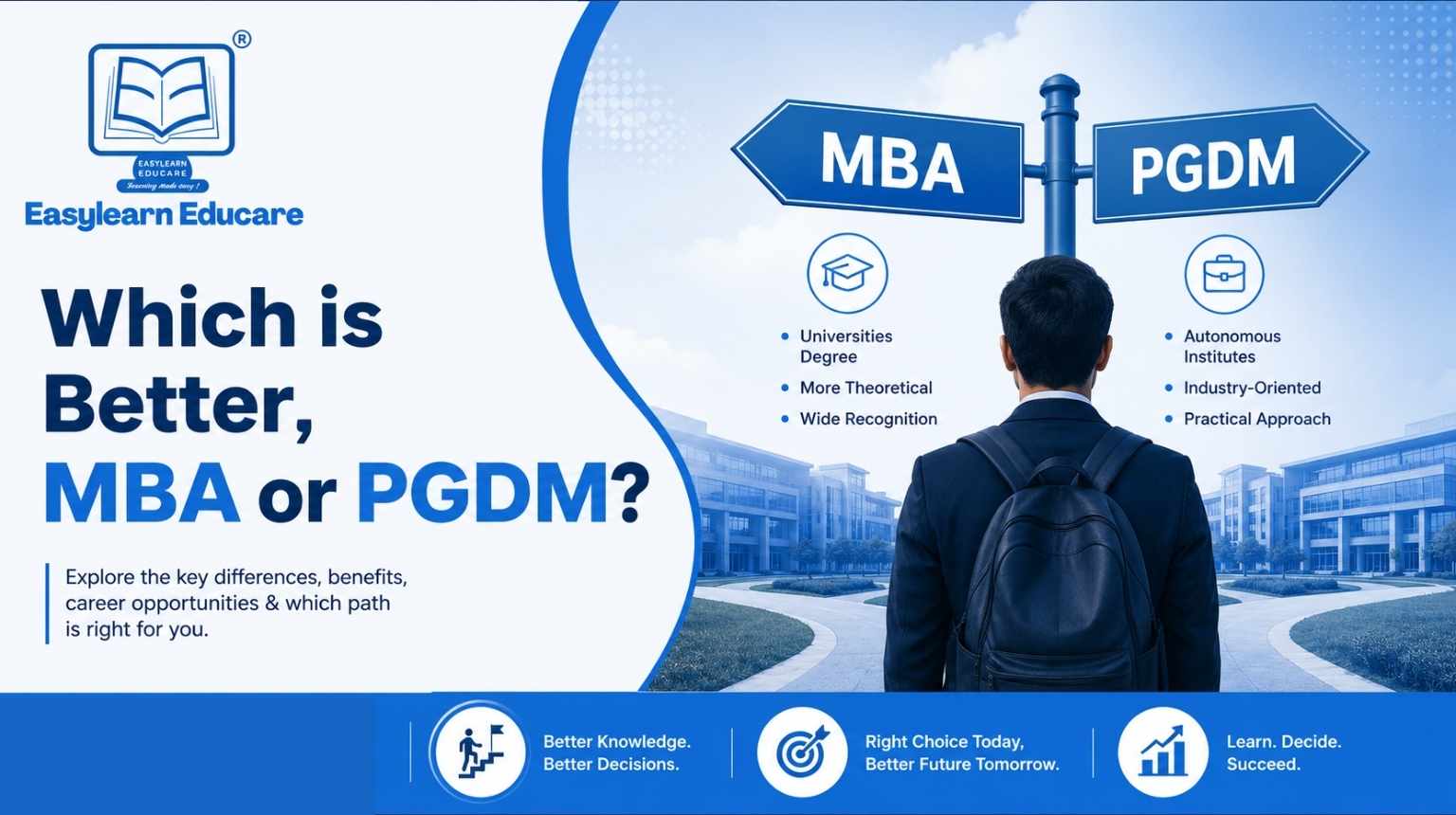
Choosing the right postgraduate management course is one of the most important decisions for students who want to build a successful career in business and management. Two of the most popular options in India are MBA (Master of Business Administration) and PGDM (Post Graduate Diploma in Management). While both programs focus on management education, they differ in several aspects, such as curriculum, recognition, industry exposure, and career opportunities. Students often get confused about which course is better for their future. The answer depends on individual career goals, learning preferences, and the type of exposure a student is looking for. At Easylern Educare, students receive proper support and guidance to make informed educational decisions that align with their ambitions. Understanding MBA An MBA is a degree program offered by universities or colleges affiliated with universities. It is approved by the University Grants Commission (UGC) and follows a structured academic curriculum. The syllabus is usually standardized and focuses on theoretical knowledge along with practical management concepts. MBA programs are ideal for students who want a strong academic foundation in business administration. The course generally includes subjects like Finance, Marketing, Human Resource Management, Operations, Business Analytics, and Entrepreneurship. One of the biggest advantages of an MBA degree is its wide recognition in both India and abroad. Since it is a degree course, it is often preferred for government jobs, higher studies like a PhD, and academic careers. Advantages of an MBA Recognized university degree Suitable for government and academic careers Affordable in many universities Strong theoretical and conceptual learning Accepted globally for higher education opportunities However, some MBA programs may not update their curriculum frequently, which can sometimes create a gap between academic learning and industry requirements. Understanding PGDM PGDM stands for Post Graduate Diploma in Management. It is offered by autonomous institutes approved by AICTE (All India Council for Technical Education). Unlike MBA programs, PGDM institutes have the flexibility to design and update their curriculum according to changing industry trends. PGDM courses are generally more industry-oriented and practical. The syllabus is updated regularly to include modern business practices, digital marketing, artificial intelligence in business, data analytics, and leadership training. Many top business schools in India offer PGDM programs because they can adapt faster to the needs of companies and employers. Students often get more exposure through internships, workshops, corporate interactions, live projects, and skill-based training. Advantages of PGDM Industry-focused curriculum Frequent syllabus updates Better practical exposure Strong corporate networking opportunities Emphasis on leadership and soft skills The main concern for some students is that PGDM is a diploma and not a degree. However, many reputed PGDM institutes now offer equivalence to MBA degrees through accreditation bodies, making them highly valuable in the job market. MBA vs PGDM: Key Differences 1. Course Structure MBA programs follow a university-designed syllabus that changes less frequently. PGDM institutes can modify their curriculum according to current market demands. 2. Focus Area MBA focuses more on theoretical and academic concepts, whereas PGDM emphasizes practical learning and industry exposure. 3. AffiliationAn MBA is a degree program affiliated with universities. PGDM is a diploma program offered by autonomous institutes approved by AICTE. 4. Industry Exposure PGDM students often receive greater corporate exposure through seminars, workshops, internships, and industry projects. 5. Career Opportunities Both courses provide excellent career opportunities. However, the quality of the institute matters more than the course title itself. Which One Should You Choose? The choice between MBA and PGDM depends on your career goals. If you want: A university degree Lower course fees Eligibility for government jobs or a PhD Academic-oriented learning Then an MBA may be the better option for you. On the other hand, if you prefer: Practical learning Industry-relevant skills Corporate exposure Modern business training Then PGDM can be a better choice. Students should also evaluate factors such as faculty quality, placement records, infrastructure, specialization options, and industry partnerships before selecting a course. Importance of Career Guidance Many students make the mistake of choosing a management course based only on popularity or peer pressure. A wrong decision can affect long-term career growth. This is why professional counselling becomes extremely important. Easylern Educare helps students understand their strengths, interests, and career aspirations before selecting the right management program. With expert advice and personalized counselling, students can make confident decisions about their future. As one of the providers of the best Career Guidance & Counselling services, the organization assists students in identifying the right colleges, entrance exams, and specialization areas based on their goals. Final Thoughts There is no single answer to whether an MBA or PGDM is better. Both programs have their own strengths and advantages. The real success depends on choosing the right institute, gaining practical knowledge, building communication skills, and staying updated with industry trends. Students should carefully analyze their career objectives before making a final decision. Whether you choose an MBA or PGDM, dedication, skill development, and continuous learning will play the biggest role in achieving career success. For students seeking expert educational support, Easylern Educare has earned a reputation as a trusted and best education consultancy in Kolkata, helping aspiring professionals take the right step toward a bright future.
IELTS Exam Pattern: A Complete Guide for Students
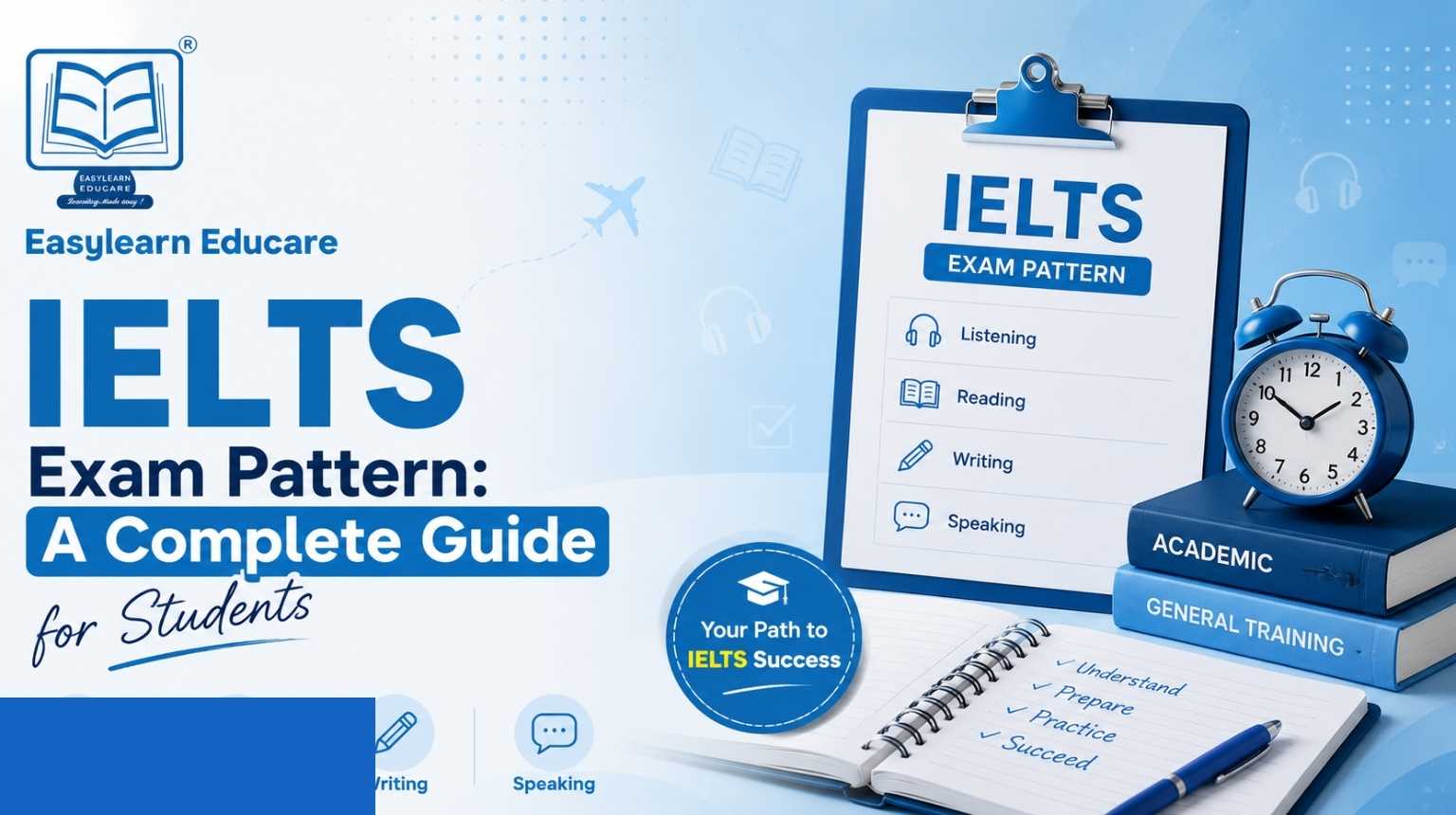
The International English Language Testing System (IELTS) is one of the most recognized English proficiency exams in the world. Every year, millions of students and professionals appear for the test to study, work, or migrate abroad. Understanding the IELTS exam pattern is the first and most important step toward achieving a high band score. Whether you are planning to study in countries like the UK, Canada, Australia, or New Zealand, knowing the structure of the IELTS exam can help you prepare effectively and confidently. What is the IELTS Exam? IELTS is designed to evaluate a candidate’s English language skills in four key areas: Listening Reading Writing Speaking The exam is jointly managed by the British Council, IDP: IELTS Australia, and Cambridge Assessment English. It is accepted by thousands of universities, employers, and immigration authorities worldwide. Students seeking professional guidance for overseas education often consult institutes like Easylern Educare for proper preparation strategies and counselling support. Types of IELTS Exams There are two major types of IELTS tests: 1. IELTS Academic This version is for students who wish to pursue higher education abroad or apply for professional registration. 2. IELTS General Training This version is suitable for migration, work experience, or secondary education in English-speaking countries. Both test formats have the same Listening and Speaking sections, but the Reading and Writing sections differ slightly. IELTS Exam Pattern Overview The IELTS exam is divided into four sections. The total duration of the exam is approximately 2 hours and 45 minutes. Section Duration Number of Questions Listening 30 Minutes 40 Questions Reading 60 Minutes 40 Questions Writing 60 Minutes 2 Tasks Speaking 11–14 Minutes Face-to-face Interview Let’s understand each section in detail. IELTS Listening Section The Listening test lasts for 30 minutes and consists of four recorded audio clips. Candidates must answer 40 questions based on these recordings. Format of the Listening Test Part 1: Conversation between two people Part 2: Monologue on an everyday topic Part 3: Academic discussion among multiple speakers Part 4: Academic lecture or talk Important Tips Listen carefully to instructions Practice note-taking Focus on spelling and grammar Improve concentration while listening Regular practice with mock tests can significantly improve listening skills. IELTS Reading Section The Reading section is 60 minutes long and contains 40 questions. IELTS Academic Reading Includes passages from books, journals, newspapers, and academic texts. IELTS General Reading Contains everyday materials such as advertisements, notices, company handbooks, and articles. Types of Questions Multiple choice Matching headings True/False/Not Given Sentence completion Summary completion Preparation Tips Improve reading speed Learn skimming and scanning techniques Practice vocabulary daily Manage time effectively Many students struggle with time management in this section, so regular practice is essential. IELTS Writing Section The Writing section also lasts 60 minutes and consists of two tasks. IELTS Academic Writing Task 1: Describe graphs, charts, or diagrams Task 2: Write an essay on a given topic IELTS General Writing Task 1: Write a letter Task 2: Essay writing Scoring Criteria Examiners evaluate: Task achievement Grammar accuracy Vocabulary usage Coherence and cohesion Tips for Better Writing Scores Practice essay structures Use formal language Avoid grammatical errors Develop ideas clearly Professional mentoring from the best education consultancy in Kolkata can help students improve writing techniques and overall exam confidence. IELTS Speaking Section The Speaking test is conducted face-to-face with an examiner and lasts between 11 to 14 minutes. Parts of the Speaking Test Part 1: Introduction and Interview Questions about personal life, hobbies, studies, and interests. Part 2: Cue Card Candidates receive a topic and get one minute to prepare before speaking for two minutes. Part 3: Discussion A deeper discussion related to the cue card topic. Tips to Score Well in Speaking Speak confidently and naturally Avoid memorized answers Improve pronunciation Expand answers with examples The speaking test evaluates fluency, grammar, pronunciation, and vocabulary. IELTS Band Score System IELTS scores are measured on a band scale from 0 to 9. Band Score Skill Level 9 Expert User 8 Very Good User 7 Good User 6 Competent User 5 Modest User Most universities abroad require a minimum score between 6.0 and 7.5, depending on the course and institution. Computer-Based vs Paper-Based IELTS Students can choose between: Computer-delivered IELTS Paper-based IELTS Both formats have the same difficulty level, question types, and scoring system. The Speaking test remains face-to-face in both formats. Which One Should You Choose? Choose computer-based if you type faster Choose paper-based if you prefer writing by hand Selecting the right format depends on your comfort level. Common Mistakes Students Should Avoid Many candidates lose marks due to avoidable errors, such as: Poor time management Lack of vocabulary Ignoring instructions Writing incomplete answers Speaking too little Consistent preparation and expert guidance can help students overcome these challenges effectively. Final Thoughts Understanding the IELTS exam pattern is essential for achieving a good band score. Each section tests specific language abilities, and success depends on regular practice, smart strategies, and confidence. Students planning to study abroad should start their preparation early and seek professional support whenever needed. Easylern Educare provides students with proper guidance, preparation support, and the best Career Guidance & Counselling to help them achieve their international education goals. With the right preparation plan and dedication, scoring high in IELTS becomes much easier.
Study in the UK for Indian Students: A Complete Guide

Studying abroad has become a dream for many students who want global exposure, quality education, and better career opportunities. Among all international destinations, the United Kingdom remains one of the most preferred choices for higher education. Every year, thousands of Indian students choose the UK because of its world-class universities, multicultural environment, and globally recognized degrees. If you are planning to study in the UK for Indian students, understanding the admission process, scholarships, eligibility, and career opportunities can help you make the right decision. Why Choose the UK for Higher Education? The UK is home to some of the world’s top-ranked universities and offers a strong academic system that focuses on practical learning and research. Students receive internationally recognized qualifications that improve their career prospects worldwide. Benefits of Studying in the UK There are several benefits of studying in UK universities for Indian students: 1. Globally Recognized Degrees UK universities are known for high academic standards. Degrees from UK institutions are respected by employers around the world. 2. Shorter Course Duration Compared to many countries, undergraduate and postgraduate programs in the UK are shorter. Most master’s degrees are completed within one year, helping students save both time and tuition costs. 3. Excellent Career Opportunities Students gain practical knowledge and industry exposure through internships, projects, and placement programs. This helps improve employability after graduation. 4. Multicultural Environment The UK welcomes students from different countries and cultures. Indian students can experience a diverse and inclusive environment while building global networks. 5. Post-Study Work Opportunities The UK Graduate Route allows international students to stay and work in the country after completing their studies. This creates excellent opportunities for career growth and international work experience. Popular Courses for Indian Students in the UK Indian students choose the UK for a wide range of academic programs, including: Business and Management Engineering and Technology Data Science and Artificial Intelligence Law and Legal Studies Healthcare and Nursing Computer Science and IT Finance and Accounting Media and Communication Students should select a course based on their interests, career goals, and future job opportunities. Study in the UK Without IELTS Many students worry about English language proficiency tests while applying abroad. The good news is that some universities allow students to study in UK without IELTS under certain conditions. Universities may accept: English scores from previous education Alternative tests like PTE or Duolingo Medium of Instruction (MOI) certificates Internal university language assessments However, eligibility criteria vary between universities, so students should carefully check admission requirements before applying. Scholarship to Study in UK The cost of international education can sometimes be challenging for students and families. Fortunately, there are several scholarships to study in UK programs available for Indian students. Types of Scholarships Available Merit-Based Scholarships These are awarded to students with excellent academic performance. Government Scholarships Programs like Chevening Scholarships and Commonwealth Scholarships support international students. University Scholarships Many UK universities provide partial or full tuition fee waivers for international students. Subject-Specific Scholarships Some scholarships are offered for specific courses such as engineering, business, or healthcare. Applying early and maintaining strong academic records can increase the chances of receiving scholarships. Admission Requirements for UK Universities Although admission criteria vary across universities, most institutions require: Academic transcripts Passport copy Statement of Purpose (SOP) Letters of Recommendation (LOR) English language proficiency proof Updated resume or CV Students applying for postgraduate programs may also need work experience, depending on the course. Student Visa Process for the UK Indian students need a UK Student Visa to study in the country. After receiving an admission offer and Confirmation of Acceptance for Studies (CAS), students can begin the visa application process. Required documents generally include: Valid passport CAS letter Financial proof Academic documents Tuberculosis test report Visa application form Applying for the visa early can help avoid delays before course commencement. Living in the UK as an Indian Student The UK offers a safe and student-friendly environment with modern infrastructure and excellent public transport systems. Cities like London, Manchester, Birmingham, Edinburgh, and Glasgow are highly popular among international students. Students can also work part-time during their studies to manage living expenses and gain professional experience. Role of Study in UK Consultants The process of studying abroad involves university selection, application filing, visa documentation, scholarships, and financial planning. This is why many students prefer taking help from professional study in UK consultants. Experienced consultants can guide students regarding: University selection Course recommendations Scholarship opportunities Visa application support Interview preparation Career counseling Professional guidance can simplify the admission process and reduce the chances of errors during applications. If you are planning your overseas education journey, Easylern Educare can help students make informed decisions with expert counseling and admission support. How to Prepare for Studying in the UK? Students should start preparing at least 8-12 months before their intended intake. Important preparation steps include: Researching universities and courses Preparing required documents Improving communication skills Planning finances and accommodation Applying for scholarships early Students can also get Career Guidance & Counselling from experienced professionals to understand the best academic and career options available. For students seeking trusted guidance, choosing the best study abroad consultancy in Kolkata can help simplify the entire study abroad journey from admission to visa processing. Conclusion The UK continues to be one of the best destinations for Indian students seeking quality education, international exposure, and better career opportunities. With globally recognized universities, shorter course durations, scholarships, and post-study work opportunities, studying in the UK can become a life-changing experience. Whether you want to study in the UK without IELTS, apply for scholarships, or explore career-focused programs, proper planning and expert guidance can make the process smoother and more successful. With the right support from educational consultants like Easylern Educare, students can confidently achieve their dream of studying abroad.
Best Courses After 12th (Biology, Medical & Para‑Medical 2026)

If you have just completed 12th with Biology (PCB) and are confused about “what next?”, you are standing at one of the most exciting crossroads in your academic life. The biology stream opens doors to careers in medicine, healthcare, research, biotechnology, agriculture, and allied health sciences. In this blog, we will explore the best courses after 12th in Biology, Medical, and Para‑medical fields, so you can choose a path that matches your interests, aptitude, and future goals. Top Medical Courses After 12th 1. MBBS – Bachelor of Medicine & Surgery MBBS is the most sought‑after course for students who want to become doctors. It is a 5.5‑year program (including 1‑year internship) that covers anatomy, physiology, pathology, pharmacology, surgery, and clinical practice. Admission is usually through NEET‑UG, and graduates can work in hospitals, clinics, or later pursue MD/MS specialisations. 2. BDS – Bachelor of Dental Surgery If you are interested in oral health rather than general medicine, BDS is an excellent option. The course lasts 5 years (including internship) and trains students in dental examination, surgery, orthodontics, and restorative procedures. BDS graduates can open private clinics, join hospitals, or work in dental research and public‑health programs. 3. BAMS / BHMS / BUMS – Ayurveda, Homoeopathy & Unani Medicine For students interested in traditional systems of medicine, BAMS (Bachelor of Ayurvedic Medicine and Surgery), BHMS (Homoeopathy), and BUMS (Unani) are popular choices. These are 5–5.5-year degrees that combine ancient healing systems with modern medical science and are recognised by the respective councils. Popular Para‑Medical & Allied Health Courses 1. B.Sc Nursing B.Sc Nursing is a 4‑year undergraduate program that prepares students to work in hospitals, ICUs, OTs, and community‑health settings. Nurses are in high demand across private and government hospitals, nursing homes, and abroad, making this a stable and rewarding career choice. 2. BPT – Bachelor of Physiotherapy BPT is a 4.5‑year degree (including internship) that trains students to treat patients with injuries, neurological disorders, and musculoskeletal problems through physical therapy. Physiotherapists are needed in hospitals, sports‑medicine centres, geriatric clinics, and rehabilitation centres. 3. B.Pharm – Bachelor of Pharmacy B.Pharm is a 4‑year course that focuses on drugs, formulations, pharmacology, and quality control. Graduates can work in pharmaceutical companies, hospitals, regulatory bodies, drug‑store chains, and research labs. 4. Medical Laboratory Technology (BMLT / DMLT) BMLT (Bachelor of Medical Laboratory Technology) and DMLT (Diploma) train students to perform blood tests, microbiological analysis, and other diagnostic procedures. These professionals are crucial in pathology labs, hospitals, and diagnostic centres, and the demand is growing in both urban and rural areas. Science & Research‑Oriented Courses 1. B.Sc in Biotechnology / Microbiology / Biochemistry These 3‑year B.Sc programs are ideal for students who enjoy biology and laboratory work. Biotechnology, microbiology, and biochemistry graduates can work in research organisations, pharma labs, food‑testing units, and biotech startups. 2. B.Sc in Environmental Science / Agriculture / Forestry Students interested in sustainability, farming, and environmental management can opt for B.Sc in Environmental Science, Agriculture, or Forestry. Careers include roles in environmental agencies, NGOs, government departments, and agri‑business organisations. Unique & Emerging Options 1. Nutrition & Dietetics B.Sc Nutrition and Dietetics prepares students to plan meals, manage clinical nutrition, and advise on healthy lifestyles. Graduates can work in hospitals, fitness centres, private practice, or corporate wellness programs. 2. Forensic Science For biology students interested in crime‑scene investigation and forensic medicine, B.Sc Forensic Science is a niche but growing field. Professionals work in forensic labs, police departments, and legal‑health units. 3. Paramedical Technology Diplomas Shorter diplomas, such as Medical Lab Technology, X‑Ray Technology, Dialysis Technology, and OT‑Technology, are job‑oriented and can be completed after 12th. These courses train students to support doctors and surgeons in hospitals and diagnostic centres. How to Choose the Right Course? Choosing the right course after 12th depends on three main factors: Interest: Do you enjoy direct patient care (MBBS, BDS, Nursing), lab work (BMLT, Biotechnology), or research (B.Sc Biological Sciences)? Aptitude: Are you comfortable with long study hours and entrance exams (NEET‑UG, state‑level tests), or do you prefer shorter, skill‑based diplomas? Career goals: Are you aiming for a high‑salary, long‑term career in medicine, or a stable, early‑entry job in paramedical or allied health? If you still feel confused about which course to pick, it helps to talk to experienced counsellors who understand the latest trends in medical and para‑medical education. Get free counselling today, the best education consultancy in Kolkata and clarify your NEET strategy, course options, and college lists with expert guidance. Frequently Asked Questions (FAQs) 1. What are the best courses after 12th (Biology stream)? Top courses include MBBS, BDS, B.Pharm, B.Sc Nursing, BPT, B.Sc Biotechnology, Microbiology, and paramedical programs like BMLT and Medical Lab Technology. 2. Do I need NEET for all medical and para‑medical courses? Most medical courses, such as MBBS, BDS, BAMS, BHMS, and BUMS, require NEET‑UG. However, many paramedical and allied‑health courses (B.Sc Nursing, BPT, B.Pharm, BMLT, etc.) have their own entrance exams or merit‑based admission. 3. Can I do Nursing without NEET? In India, many private and some government nursing colleges admit students through separate entrance tests or merit in 12th PCB/Biology. Some state‑level nursing entrances also do not depend on NEET‑UG. 4. Which has a better scope: MBBS or paramedical courses? MBBS offers the highest prestige and long‑term earning potential but requires extremely competitive preparation. Paramedical and allied‑health courses (BPT, B.Sc Nursing, BMLT, etc.) offer quicker job entry, good salary, and high demand in hospitals and clinics. 5. Are B.Sc Biotechnology and Microbiology good career options? Yes. Both B.Sc Biotechnology and Microbiology lead to jobs in research labs, pharmaceutical companies, food and beverage industries, environmental monitoring, and teaching. 6. What are the best paramedical courses after 12th without NEET? Popular options include BPT, B.Sc Nursing, BMLT, DMLT, radiology & imaging technology, dialysis technology, and OT‑technology programs offered by many universities and private colleges. 7. Can I switch to non‑medical courses after 12th Biology? Yes. Many students move into B.Sc Mathematics, Computer Science (with Physics), or even commerce and management …
Continue reading “Best Courses After 12th (Biology, Medical & Para‑Medical 2026)”
Best Universities for UG Programs in India: Most In-Demand After 4-5 Years

Choosing the right undergraduate program sets the foundation for a thriving career, especially in India’s dynamic job market. Universities that blend academic rigor with future-ready skills like AI, sustainability, and digital innovation will dominate demand in 4-5 years. Why Future Demand Matters India’s higher education landscape is evolving rapidly, with NIRF rankings and global indices like QS highlighting institutions excelling in employability and research. Programs in engineering, data science, biotech, and management from top universities produce graduates sought by tech giants, startups, and multinationals. Projections show demand surging for skills in AI/ML, renewable energy, and healthcare tech by 2030, making alumni from these schools highly recruitable. Top Universities for High-Demand UG Programs Indian Institute of Science (IISc) Bangalore IISc tops NIRF rankings for its cutting-edge UG programs in sciences and engineering. Its BS Research program emphasizes interdisciplinary research in AI, quantum computing, and biotech- fields exploding in demand. Graduates often land roles at Google, ISRO, or pursue PhDs abroad, with placements averaging ₹30-50 LPA after 4 years. Jawaharlal Nehru University (JNU), New Delhi JNU excels in BA programs across languages, social sciences, and sciences via CUET admissions. Its focus on policy, environment, and international relations prepares students for think tanks, NGOs, and diplomacy. In 4-5 years, JNU alumni will be prized for expertise in sustainable development amid global challenges. IIT Madras, Chennai Renowned for BTech in AI, Data Science, and Electronics, IIT Madras leads with its online UG degrees and on-campus excellence. JEE Advanced qualifiers benefit from world-class labs and industry ties with TCS and Infosys. Future job markets in semiconductors and EVs will favor its grads, boasting 95% placement rates. Banaras Hindu University (BHU), Varanasi BHU offers diverse UG courses in engineering, medical sciences, and arts through CUET. Its IMS-BHU for MBBS and IIT-BHU for tech stand out, with strong alumni networks in healthcare and manufacturing. As India pushes ‘Make in India’, BHU degrees will see sustained demand in the pharma and infra sectors. Jamia Millia Islamia (JMI), New Delhi JMI’s UG programs in engineering, mass communication, and law shine via JEE/CUET. It ranks high for research in social sciences and media, ideal for digital marketing and policy roles. With media jobs booming, JMI grads will thrive in content and analytics firms post-graduation. In-Demand Fields and Placement Trends Field Key Universities Projected Demand (2030) Avg Starting Salary AI/Data Science IIT Madras, IISc High (Tech/Analytics) ₹20-40 LPA Engineering (EVs/Semi) IITs, BHU Very High (Manufacturing) ₹15-35 LPA Biotech/Healthcare JNU, BHU Growing (Pharma) ₹12-25 LPA Business/Management Praxis, IQ City Steady (Startups) ₹8-20 LPA Social Sciences/Media JMI, JNU Emerging (Policy/Media) ₹10-22 LPA These fields leverage India’s digital boom, with 1.5 crore jobs expected in tech alone. Top universities report 90%+ placement rates, rising further as alumni networks mature. Admissions typically require CUET, JEE Main/Advanced, or NEET, with cutoffs varying by category. Fees range from ₹10,000 (public) to ₹5 lakhs/year (private), but scholarships abound for meritorious students. Skills for Future-Proofing Your Career Beyond degrees, universities emphasizing internships, projects, and certifications (e.g., AWS, Google Analytics) ensure an edge in job hunts. Coding bootcamps at IITs or research at IISc build portfolios that employers value 4-5 years out. Get free counseling today, the best education consultancy in Kolkata. FAQs Which entrance exams are needed for top UG programs? CUET for JNU/BHU/JMI; JEE Main/Advanced for IITs; NEET for medical at BHU. Check official sites for 2026 updates. What makes IISc the top choice for UG sciences? Its research-focused BS program and NIRF #1 rank ensure global opportunities in AI/biotech. How do placements look after 4-5 years? Alumni from IITs/JNU average ₹25+ LPA mid-career, driven by skill demand in tech/healthcare. Can I switch streams post-UG from these universities? Many offer flexible electives; JMI/JNU support interdisciplinary shifts via PG routes. What scholarships are available? Merit-cum-means at IITs/BHU; institute-specific aid covers 50-100% fees for low-income students. How does location impact demand? Delhi/Bangalore hubs (JNU/IISc) offer better internships; Kolkata options like Praxis suit East India aspirants.
Top 11 Private Engineering Colleges in Pan-India
Searching for the best private engineering colleges in India usually starts with one big thought, i.e. “a college that will give me a solid B.Tech degree, good placements, and fees that won’t break my family’s budget.” The tricky part is that “best” looks different for different students. A CSE-focused aspirant may prioritise coding culture and recruiters, while someone leaning toward ECE or Mechanical may care more about labs, industry tie-ups, and internships. In this guide, you’ll find a practical shortlist, a quick comparison table, and a real-world breakdown of what each campus offers, so you can choose confidently (not emotionally). If you want your options sorted by your rank, budget, and city preference, speaking with a best education counsellor at an education consultancy in India can save you from last-minute, high-stakes mistakes during admissions. What Are the Best Private Engineering Colleges in Pan-India? College / University Popular Engineering Courses Average Fees (Approx.) Average Placement (Approx.) SRM IST CSE, AI/ML, ECE, Mechanical ₹2.5–4.5 L/year ₹6.68 LPA VIT CSE, IT, AI/DS, ECE Category-based varies ₹7.23 LPA (B.Tech avg) KIIT CSE, IT, ECE, EE Varies by program ₹9.5 LPA Parul University CSE, IT, Mechanical, Civil Varies by program ₹6 LPA Sharda University CSE, AI/ML, ECE, Civil Varies by program ₹6–7 LPA Ganpat University CSE, IT, Mechanical, Civil ₹1.0–2.2 L/year ₹3.9–4.2 LPA IZee Programs vary by institute Varies ₹7 LPA Heritage Institute of Technology CSE, IT, ECE, EE ₹0.70 L/semester + fees ₹4.78 LPA IEM Kolkata CSE, IT, ECE ₹8.65 L ₹6 LPA Techno India University CSE, IT, ECE ₹6.48 L ₹11 LPA Netaji Subhash Engineering College – NSEC CSE, IT, ECE, EE ₹6.97 L ₹11.3 LPA Note: Fees and placements vary by branch, campus, and year. The numbers below are typical ranges / reported averages from publicly available sources and should be used for shortlisting, not as a final promise. What Makes Each Private Engineering College Worth Considering? 1) SRM IST |Chennai Courses: CSE (with specialisations), AI/ML, ECE, Mechanical, Civil. Amenities: A big campus with plenty going on, clubs, events, labs, and a busy student crowd. You’ll find a lot of chances to join communities if you’re proactive. Placements: Large recruiter participation every year; reported average package around ₹6.68 LPA. Why it stands out: SRM is a good fit if you want options, multiple branches, multiple specialisations, and enough activity on campus to help you build your profile outside the classroom. 2) VIT | Vellore Courses: CSE, IT, AI/DS, ECE, Mechanical, and more. Amenities: Well-organised campus life with lots of student groups, competitions, and skill-based activities. It’s the kind of place where you’ll always find people preparing for internships or coding events. Placements: B.Tech average package reported around ₹7.23 LPA Why it stands out: For students searching for top private engineering colleges in India for CSE, VIT is often shortlisted because of its strong tech-focused student culture and consistent campus hiring. 3) KIIT | Bhubaneswar Courses: CSE/IT, ECE, EE, Mechanical, etc. Amenities: A large university-style setup, good infrastructure, plenty of campus facilities, and a lot of student diversity. Placements: Reported average package shown around ₹9.5 LPA. Why it stands out: KIIT works well for students who want a full campus experience with decent placement activity, and who prefer a big university environment where there’s always something happening. 4) Parul University | Vadodara Courses: CSE, IT, Mechanical, Civil, plus multiple specialisations. Amenities: A broad campus with many departments and activities. It’s a popular option for students who want straightforward admission pathways and a wide range of programs. Placements: An average of around ₹6 LPA. Why it stands out: If your focus is value for money, Parul is often considered by students who want private university options without going into the premium-fee range. 5) Sharda University | Greater Noida Courses: CSE, AI/ML, ECE, Civil, Mechanical and more. Amenities: Being in the NCR region is a plus, more exposure, more events, and more internship possibilities if you actively search and apply. Placements: The placement summary shows an average of ₹6–7 LPA in reviews. Why it stands out: Sharda is a decent pick if you want the advantage of being near a major metro region and prefer a university that offers many branch options under one umbrella. 6) Ganpat University (GUNI) |Gujarat Courses: CSE, IT, Mechanical, Civil and allied programs. Amenities: A calmer, campus-focused environment. Good for students who want a stable routine, fewer distractions, and a clear academic path. Placements: Reported average around ₹3.9–4.2 LPA. Why it stands out: This is usually shortlisted by students who are budget-conscious and want a recognised private university option with standard placement support. 7) IZee | Bengaluru Courses: Program availability can differ across IZee institutes. Verify the exact engineering program, approvals, and campus details before finalising. Amenities: Bengaluru location is a natural advantage, with more tech exposure, events, and internship opportunities nearby (if you hustle for them). Placements: An average package of around ₹7 LPA for published placement summary. Why it stands out: It can be worth considering if you specifically want a Bengaluru ecosystem, but treat it like a “verify first” option; confirm the exact course structure and campus details before committing. 8) Heritage Institute of Technology | Kolkata Courses: CSE, IT, ECE, EE, Mechanical, Civil, more. Amenities: Good academic structure, strong enough labs for most branches, and a campus culture where students actively participate in clubs and events. Fees: The semester-wise fee structure is published. Placements: Reported around ₹4.78 LPA. Why it stands out: Heritage is often picked for its balanced mix, reasonable campus life, decent academics, and stable placement support in Kolkata. 9) IEM Kolkata | Salt Lake Courses: CSE, IT, ECE and related programs. Amenities: Strong “training + discipline” vibe. Students here usually focus early on placements, skills, and internships. Fees: Total B.Tech (CSE) fee reported around ₹8.65 L (indicative). Placements: Median package for B.Tech is reported to be around ₹6 LPA. Why it stands out: If you want a college that’s strongly placement-oriented and competitive, IEM is one of the names students repeatedly shortlist …
Continue reading “Top 11 Private Engineering Colleges in Pan-India”
Choosing the Right B.Tech College After WBJEE: Expert Counselling Insights from Kolkata

If you’re reading this right after your WBJEE result, you’re probably stuck between two thoughts: “I finally did it”, and about the next step. The counselling phase feels deceptively simple: log in, fill out choices, wait for allotment. But students guided by the best career counsellor in Kolkata on WBJEE counselling in Kolkata know the truth: most “bad” outcomes don’t happen because a student had a low rank. They happen because choices were made without a plan. WBJEEB conducts centralised online e-counselling for engineering and technology programs in West Bengal, and the process runs through multiple rounds (including an upgradation and a Mop-Up round). That means you get more than one opportunity, but only if you understand how the system rewards smart preference ordering. Let’s break this down like a counsellor would, with practical steps and Kolkata-specific considerations that students often miss. Step 1: Start With “Branch Vs College” Before you open the choice-filling page for student counselling after 12, answer this question: What Matters More To You Right Now, Your Branch Or Your College Brand There’s no universal right answer, but there is a right answer for you. If you’re set on CSE/IT and want tech roles, prioritising the branch makes sense, because your first two years will build your fundamentals, and internships tend to follow that track. If you’re flexible on branch (say, ECE/EE/IT/CSE) and you value alumni network, exposure, and a competitive peer group, you may prioritise college. If you’re unsure, don’t guess. Look at your interests and your comfort with math-heavy circuits vs coding-heavy work. Counselling Insight: Many students in Kolkata pick “CSE at any cost” without checking whether the campus, labs, and peer ecosystem support strong learning. The result is disappointment in the second year. Easylearn Educare can help you pick a branch you can actually live with during tough weeks. Step 2: Use WBJEE Rank The Right Way Your GMR is not a verdict. It’s a tool. Instead of asking about the college you can enrol in, ask: Which colleges/branches were available near my rank in recent counselling cycles (Look at opening/closing ranks, not just one-year rumours.) How volatile is the cutoff for this branch (Some branches swing more depending on the seat matrix and demand) Do I have category/TFW benefits that change my realistic options WBJEE counselling in Kolkata is web-based, and seat allotment depends on rank, preferences, and seat availability. So your rank must be paired with a smart preference list, not a short list. Step 3: Build A “Kolkata Radius” Plan Students often underestimate the impact of commuting and location on performance. When you’re comparing engineering colleges, Easylearn Educare is here to make the task hassle-free. College / University Popular B.Tech Courses Average Annual Fees Average Placement Package SRM Institute of Science & Technology CSE, AI & ML, ECE, Mechanical ₹2.5–3.5 L ₹6–8 LPA VIT University CSE, IT, AI & Data Science, ECE ₹2–3 L ₹7–9 LPA KIIT University CSE, IT, ECE, Electrical ₹2–3 L ₹5–7 LPA Parul University CSE, Mechanical, Civil, IT ₹1–1.8 L ₹3–4.5 LPA Sharda University CSE, AI & ML, ECE, Civil ₹1.8–2.5 L ₹4–6 LPA Ganpat University CSE, IT, Mechanical, Civil ₹1–1.5 L ₹3–4 LPA Izee College Computer Science, IT ₹80K–1.2 L ₹2.5–3.5 LPA Note: Fees and placement figures are approximate averages and may vary each year depending on the program, specialisation, and placement cycle. A college that looks perfect on paper can feel exhausting if you spend 3 hours a day in transit. On the flip side, a slightly less “hyped” institute that’s closer can give you time to build skills, coding practice, projects, internships, things that actually shape outcomes. All this process can be made easier. Call us at +918240409187 or email us at ask@easylearn.com, and let our professional admission consultants in Kolkata help students across West Bengal achieve their career goals. Step 4: Don’t Copy Someone Else’s Preference Order This is the most common mistake in WBJEE choice filling: students copy a friend’s list or follow a coaching centre’s “one-size-fits-all” order. Your preference order should reflect: Your branch priority Your location constraints Your budget (fees + hostel + transport) Your risk appetite (safe options vs ambitious options) Golden rule: Put your dream choices first, but include enough safe choices so you don’t end up with an avoidable last-minute scramble. WBJEE counselling typically runs across multiple rounds, including Mop-Up. But relying on Mop-Up as your “main plan” is risky because vacancies and options can change quickly. Step 5: Evaluate Colleges On 7 Real Factors Placements matter, but “placement posters” don’t tell the full story. Use this checklist crafted by the Easylearn Educare experts. . 1) Department Strength (For Your Branch) Ask about: Labs and equipment Faculty stability Electives and special tracks Recent student projects 2) Internship Culture Look for: Students doing internships in their 2nd/3rd year Industry tie-ups, hackathons, tech communities Alumni guidance for referrals 3) Peer Group And Competition A strong peer group pushes you to do more, such as coding contests, projects, research, and clubs. 4) Campus Life + Learning Ecosystem Clubs, fests, maker spaces, coding cells, and seminar culture shape your confidence. 5) Fees, Scholarships, And Roi Don’t look at tuition alone. Add: transport/hostel exam fees and miscellaneous costs laptop and learning expenses 6) Hostel And Safety This is non-negotiable for many families. 7) Your Personal Fit Some students thrive in strict environments, others in flexible ones. Choose what supports you. Step 6: Make Your WBJEE Choice Filling “Wide And Layered” A ranking-friendly choice list isn’t short. It’s strategic. A simple structure counsellors use: Layer A: Aspirational (High Reach) Top college + top branch combinations that may be slightly above your expected cutoff. Layer B: Realistic (Best-Fit Zone) Where your rank historically matches the branch/college combination, you’d be happy with. Layer C: Safe (Insurance Choices) Choices you are very likely to get, and you would still accept without regret. Counselling Insight: A “wide” list improves allocation chances. The WBJEE counselling notification explicitly advises candidates to be judicious and select as many possible choices to …
JEXPO Exam Pattern 2026: Complete Guide to Syllabus, Exam Date & Preparation Tips

For students aiming to build a strong technical career after Class 10, the JEXPO (Joint Entrance Examination for Polytechnics) is one of the most important entrance exams in West Bengal. Conducted by the West Bengal State Council of Technical and Vocational Education and Skill Development (WBSCT&VE&SD), JEXPO opens the gateway to diploma courses in engineering, technology, architecture, and applied sciences offered by government and private polytechnic institutes. With competition increasing every year, understanding the JEXPO Exam Pattern 2026, syllabus, important dates, and smart preparation strategies is crucial for success. This blog provides a complete overview to help students prepare confidently and strategically. JEXPO Exam Pattern 2026 (Expected) Understanding the exam pattern is the first step toward effective preparation. While the official notification for 2026 is awaited, the exam pattern is expected to follow the previous years’ structure. Mode of Examination Offline (OMR-based) Pen and paper format Type of Questions Multiple Choice Questions (MCQs) Four options for each question Total Number of Questions 100 questions Total Marks 100 marks Each correct answer: +1 mark Negative Marking No negative marking (important advantage for students) Duration 2 hours (120 minutes) Subject-wise Question Distribution The question paper is divided into three main subjects based on the Class 10 syllabus: Subject Number of Questions Marks Mathematics 50 50 Physics 25 25 Chemistry 25 25 Total 100 100 Mathematics carries the highest weightage, making it a scoring and decisive subject for rank improvement. JEXPO 2026 Syllabus (Expected) The JEXPO 2026 syllabus is based entirely on the Class 10 (Madhyamik / equivalent board) curriculum. Below is a subject-wise breakdown to help students plan effectively. Mathematics Syllabus Number System Algebraic Expressions Linear Equations Quadratic Equations Arithmetic Progression Coordinate Geometry Geometry (Triangles, Circles, Theorems) Trigonometry (Heights & Distances) Mensuration Statistics & Probability Physics Syllabus Physical Quantities & Measurements Motion & Laws of Motion Work, Power & Energy Heat & Temperature Light (Reflection & Refraction) Electricity Magnetism Chemistry Syllabus Matter & Its Composition Atomic Structure Periodic Table Chemical Reactions Acids, Bases & Salts Metals & Non-Metals Carbon & Its Compounds Students are advised to strictly follow their Class 10 textbooks, as most questions are concept-based rather than advanced numerical problems. EXPO Exam Date 2026 (Tentative) Although the official JEXPO exam date for 2026 has not yet been announced, based on previous trends: Application Form Release: January – February 2026 Last Date to Apply: March 2026 Admit Card Release: April 2026 Exam Date: April – May 2026 Result Declaration: June 2026 Counselling & Seat Allotment: June – July 2026 Students should regularly check official notifications to avoid missing deadlines. JEXPO Counselling Process Overview After the result declaration, qualified candidates must participate in the online counselling process, which includes: Online registration Choice filling of polytechnic colleges and branches Seat allotment based on rank and category Document verification Admission confirmation Choosing the right college and branch plays a vital role in future career opportunities, and many students seek expert guidance during this stage through a Student Carrier counselling consultancy to avoid wrong decisions. JEXPO 2026 Preparation Tips Preparing smartly is more important than studying for long hours. Here are some proven Preparation Tips to help students score better: 1. Focus More on Mathematics Since Mathematics carries 50% of the total marks, strengthening this subject can significantly improve rank. 2. Follow the Official Syllabus Avoid unnecessary topics. Stick strictly to the JEXPO syllabus based on Class 10 curriculum. 3. Practice Previous Year Question Papers Solving past papers helps understand: Question patterns Difficulty level Time management 4. Revise Concepts Regularly Short daily revisions help retain formulas, reactions, and laws effectively. 5. Take Mock Tests Mock tests improve speed, accuracy, and confidence before the actual exam. 6. Avoid Guesswork Even though there is no negative marking, logical attempts yield better accuracy. Why JEXPO is a Smart Career Choice Early entry into technical education Affordable course fees Strong practical exposure Opportunities for lateral entry into engineering (B.Tech) Good placement options in core industries For students who prefer skill-based learning over purely theoretical education, polytechnic through JEXPO is an excellent option. Common Mistakes to Avoid in JEXPO Preparation Ignoring Mathematics practice Studying beyond the prescribed syllabus Not revising formulas regularly Skipping mock tests Filling counselling choices without proper research Avoiding these mistakes can make a noticeable difference in your final rank. FAQs 1. What is the exam pattern of JEXPO 2026? JEXPO 2026 is expected to be an offline exam with 100 MCQs from Mathematics, Physics, and Chemistry, carrying a total of 100 marks with no negative marking. 2. What is the JEXPO 2026 syllabus based on? The syllabus is based on the Class 10 Madhyamik or equivalent board curriculum, covering basic concepts of Maths, Physics, and Chemistry. 3. Is there any negative marking in JEXPO? No, there is no negative marking in the JEXPO examination, making it student-friendly. 4. When will the JEXPO exam be conducted in 2026? The exam is tentatively expected to be held between April and May 2026, subject to official notification. 5. Is Mathematics compulsory for JEXPO? Yes, Mathematics is compulsory and carries the highest weight-age with 50 questions out of 100. 6. Can I get admission in government polytechnic colleges through JEXPO? Yes, JEXPO is the primary entrance exam for admission into government and private polytechnic colleges in West Bengal. Conclusion The JEXPO Exam Pattern 2026 is designed to test students’ fundamental understanding of Class 10 concepts rather than advanced problem-solving skills. With a clear syllabus, no negative marking, and balanced subject distribution, the exam offers a fair opportunity for well-prepared students. By understanding the syllabus, keeping track of exam dates, and following structured preparation tips, students can confidently aim for top polytechnic colleges. Early planning, regular practice, and informed counselling choices are the keys to turning JEXPO into a strong foundation for a successful technical career.