
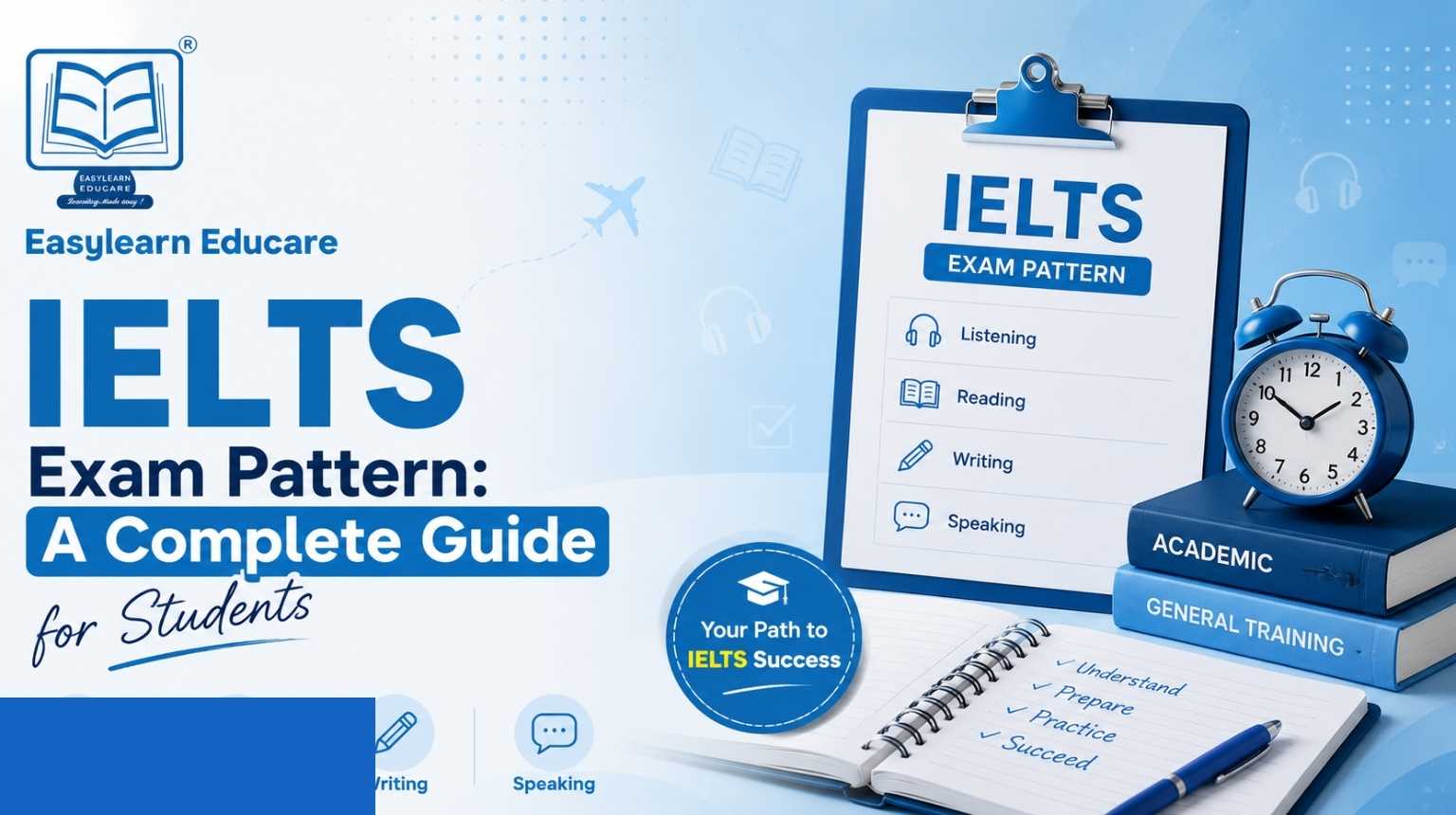
The International English Language Testing System (IELTS) is one of the most recognized English proficiency exams in the world. Every year, millions of students and professionals appear for the test to study, work, or migrate abroad. Understanding the IELTS exam pattern is the first and most important step toward achieving a high band score. Whether you are planning to study in countries like the UK, Canada, Australia, or New Zealand, knowing the structure of the IELTS exam can help you prepare effectively and confidently. What is the IELTS Exam? IELTS is designed to evaluate a candidate’s English language skills in four key areas: Listening Reading Writing Speaking The exam is jointly managed by the British Council, IDP: IELTS Australia, and Cambridge Assessment English. It is accepted by thousands of universities, employers, and immigration authorities worldwide. Students seeking professional guidance for overseas education often consult institutes like Easylern Educare for proper preparation strategies and counselling support. Types of IELTS Exams There are two major types of IELTS tests: 1. IELTS Academic This version is for students who wish to pursue higher education abroad or apply for professional registration. 2. IELTS General Training This version is suitable for migration, work experience, or secondary education in English-speaking countries. Both test formats have the same Listening and Speaking sections, but the Reading and Writing sections differ slightly. IELTS Exam Pattern Overview The IELTS exam is divided into four sections. The total duration of the exam is approximately 2 hours and 45 minutes. Section Duration Number of Questions Listening 30 Minutes 40 Questions Reading 60 Minutes 40 Questions Writing 60 Minutes 2 Tasks Speaking 11–14 Minutes Face-to-face Interview Let’s understand each section in detail. IELTS Listening Section The Listening test lasts for 30 minutes and consists of four recorded audio clips. Candidates must answer 40 questions based on these recordings. Format of the Listening Test Part 1: Conversation between two people Part 2: Monologue on an everyday topic Part 3: Academic discussion among multiple speakers Part 4: Academic lecture or talk Important Tips Listen carefully to instructions Practice note-taking Focus on spelling and grammar Improve concentration while listening Regular practice with mock tests can significantly improve listening skills. IELTS Reading Section The Reading section is 60 minutes long and contains 40 questions. IELTS Academic Reading Includes passages from books, journals, newspapers, and academic texts. IELTS General Reading Contains everyday materials such as advertisements, notices, company handbooks, and articles. Types of Questions Multiple choice Matching headings True/False/Not Given Sentence completion Summary completion Preparation Tips Improve reading speed Learn skimming and scanning techniques Practice vocabulary daily Manage time effectively Many students struggle with time management in this section, so regular practice is essential. IELTS Writing Section The Writing section also lasts 60 minutes and consists of two tasks. IELTS Academic Writing Task 1: Describe graphs, charts, or diagrams Task 2: Write an essay on a given topic IELTS General Writing Task 1: Write a letter Task 2: Essay writing Scoring Criteria Examiners evaluate: Task achievement Grammar accuracy Vocabulary usage Coherence and cohesion Tips for Better Writing Scores Practice essay structures Use formal language Avoid grammatical errors Develop ideas clearly Professional mentoring from the best education consultancy in Kolkata can help students improve writing techniques and overall exam confidence. IELTS Speaking Section The Speaking test is conducted face-to-face with an examiner and lasts between 11 to 14 minutes. Parts of the Speaking Test Part 1: Introduction and Interview Questions about personal life, hobbies, studies, and interests. Part 2: Cue Card Candidates receive a topic and get one minute to prepare before speaking for two minutes. Part 3: Discussion A deeper discussion related to the cue card topic. Tips to Score Well in Speaking Speak confidently and naturally Avoid memorized answers Improve pronunciation Expand answers with examples The speaking test evaluates fluency, grammar, pronunciation, and vocabulary. IELTS Band Score System IELTS scores are measured on a band scale from 0 to 9. Band Score Skill Level 9 Expert User 8 Very Good User 7 Good User 6 Competent User 5 Modest User Most universities abroad require a minimum score between 6.0 and 7.5, depending on the course and institution. Computer-Based vs Paper-Based IELTS Students can choose between: Computer-delivered IELTS Paper-based IELTS Both formats have the same difficulty level, question types, and scoring system. The Speaking test remains face-to-face in both formats. Which One Should You Choose? Choose computer-based if you type faster Choose paper-based if you prefer writing by hand Selecting the right format depends on your comfort level. Common Mistakes Students Should Avoid Many candidates lose marks due to avoidable errors, such as: Poor time management Lack of vocabulary Ignoring instructions Writing incomplete answers Speaking too little Consistent preparation and expert guidance can help students overcome these challenges effectively. Final Thoughts Understanding the IELTS exam pattern is essential for achieving a good band score. Each section tests specific language abilities, and success depends on regular practice, smart strategies, and confidence. Students planning to study abroad should start their preparation early and seek professional support whenever needed. Easylern Educare provides students with proper guidance, preparation support, and the best Career Guidance & Counselling to help them achieve their international education goals. With the right preparation plan and dedication, scoring high in IELTS becomes much easier.
Author Archives: eladmin
Study in the UK for Indian Students: A Complete Guide

Studying abroad has become a dream for many students who want global exposure, quality education, and better career opportunities. Among all international destinations, the United Kingdom remains one of the most preferred choices for higher education. Every year, thousands of Indian students choose the UK because of its world-class universities, multicultural environment, and globally recognized degrees. If you are planning to study in the UK for Indian students, understanding the admission process, scholarships, eligibility, and career opportunities can help you make the right decision. Why Choose the UK for Higher Education? The UK is home to some of the world’s top-ranked universities and offers a strong academic system that focuses on practical learning and research. Students receive internationally recognized qualifications that improve their career prospects worldwide. Benefits of Studying in the UK There are several benefits of studying in UK universities for Indian students: 1. Globally Recognized Degrees UK universities are known for high academic standards. Degrees from UK institutions are respected by employers around the world. 2. Shorter Course Duration Compared to many countries, undergraduate and postgraduate programs in the UK are shorter. Most master’s degrees are completed within one year, helping students save both time and tuition costs. 3. Excellent Career Opportunities Students gain practical knowledge and industry exposure through internships, projects, and placement programs. This helps improve employability after graduation. 4. Multicultural Environment The UK welcomes students from different countries and cultures. Indian students can experience a diverse and inclusive environment while building global networks. 5. Post-Study Work Opportunities The UK Graduate Route allows international students to stay and work in the country after completing their studies. This creates excellent opportunities for career growth and international work experience. Popular Courses for Indian Students in the UK Indian students choose the UK for a wide range of academic programs, including: Business and Management Engineering and Technology Data Science and Artificial Intelligence Law and Legal Studies Healthcare and Nursing Computer Science and IT Finance and Accounting Media and Communication Students should select a course based on their interests, career goals, and future job opportunities. Study in the UK Without IELTS Many students worry about English language proficiency tests while applying abroad. The good news is that some universities allow students to study in UK without IELTS under certain conditions. Universities may accept: English scores from previous education Alternative tests like PTE or Duolingo Medium of Instruction (MOI) certificates Internal university language assessments However, eligibility criteria vary between universities, so students should carefully check admission requirements before applying. Scholarship to Study in UK The cost of international education can sometimes be challenging for students and families. Fortunately, there are several scholarships to study in UK programs available for Indian students. Types of Scholarships Available Merit-Based Scholarships These are awarded to students with excellent academic performance. Government Scholarships Programs like Chevening Scholarships and Commonwealth Scholarships support international students. University Scholarships Many UK universities provide partial or full tuition fee waivers for international students. Subject-Specific Scholarships Some scholarships are offered for specific courses such as engineering, business, or healthcare. Applying early and maintaining strong academic records can increase the chances of receiving scholarships. Admission Requirements for UK Universities Although admission criteria vary across universities, most institutions require: Academic transcripts Passport copy Statement of Purpose (SOP) Letters of Recommendation (LOR) English language proficiency proof Updated resume or CV Students applying for postgraduate programs may also need work experience, depending on the course. Student Visa Process for the UK Indian students need a UK Student Visa to study in the country. After receiving an admission offer and Confirmation of Acceptance for Studies (CAS), students can begin the visa application process. Required documents generally include: Valid passport CAS letter Financial proof Academic documents Tuberculosis test report Visa application form Applying for the visa early can help avoid delays before course commencement. Living in the UK as an Indian Student The UK offers a safe and student-friendly environment with modern infrastructure and excellent public transport systems. Cities like London, Manchester, Birmingham, Edinburgh, and Glasgow are highly popular among international students. Students can also work part-time during their studies to manage living expenses and gain professional experience. Role of Study in UK Consultants The process of studying abroad involves university selection, application filing, visa documentation, scholarships, and financial planning. This is why many students prefer taking help from professional study in UK consultants. Experienced consultants can guide students regarding: University selection Course recommendations Scholarship opportunities Visa application support Interview preparation Career counseling Professional guidance can simplify the admission process and reduce the chances of errors during applications. If you are planning your overseas education journey, Easylern Educare can help students make informed decisions with expert counseling and admission support. How to Prepare for Studying in the UK? Students should start preparing at least 8-12 months before their intended intake. Important preparation steps include: Researching universities and courses Preparing required documents Improving communication skills Planning finances and accommodation Applying for scholarships early Students can also get Career Guidance & Counselling from experienced professionals to understand the best academic and career options available. For students seeking trusted guidance, choosing the best study abroad consultancy in Kolkata can help simplify the entire study abroad journey from admission to visa processing. Conclusion The UK continues to be one of the best destinations for Indian students seeking quality education, international exposure, and better career opportunities. With globally recognized universities, shorter course durations, scholarships, and post-study work opportunities, studying in the UK can become a life-changing experience. Whether you want to study in the UK without IELTS, apply for scholarships, or explore career-focused programs, proper planning and expert guidance can make the process smoother and more successful. With the right support from educational consultants like Easylern Educare, students can confidently achieve their dream of studying abroad.
Online MBA Courses in India: A Smart Choice for Working Professionals

In today’s competitive business environment, higher education has become more important than ever. Many students and working professionals are now choosing online MBA courses in India to upgrade their skills, improve career opportunities, and gain management knowledge without leaving their jobs. With the rapid growth of digital education platforms and flexible learning systems, online MBA programs are becoming one of the most preferred options for career advancement. An online MBA offers convenience, affordability, and flexibility, making it ideal for professionals who want to continue working while studying. Whether you are a fresh graduate, an entrepreneur, or an experienced employee, pursuing an online MBA can help you achieve your career goals efficiently. Why are Online MBA Courses Becoming Popular in India? There are several reasons behind the increasing popularity of online MBA courses in India: 1. Flexible Learning Schedule One of the biggest advantages of an online MBA is flexibility. Students can study according to their own schedule without attending regular classroom sessions. This is especially helpful for working professionals who cannot leave their jobs. 2. Affordable Education Traditional MBA programs can be expensive because of hostel fees, transportation, and other costs. Online MBA programs are comparatively more affordable, making quality education accessible to a larger number of students. 3. Career Growth Opportunities An MBA degree can improve leadership skills, business understanding, and decision-making abilities. Many companies prefer candidates with management qualifications for higher positions and salary growth. 4. Learn While Working Online MBA courses allow professionals to continue earning while studying. Students can directly apply what they learn in real-world work situations, making the learning process more practical. 5. Wide Range of Specializations Students can choose from multiple specializations, such as: Marketing Management Finance Management Human Resource Management Operations Management International Business Business Analytics Information Technology Management Choosing the right specialization can help students align their education with their career goals. Who Should Pursue an Online MBA? Online MBA courses are suitable for: Working professionals seeking promotions Entrepreneurs wanting business management knowledge Fresh graduates aiming for management careers Individuals looking for career changes Professionals wanting to improve leadership skills The flexibility of online education makes it easier for learners from different backgrounds to pursue higher studies. Key Benefits of Online MBA Courses in India Better Work-Life Balance Online MBA programs help students balance work, studies, and personal life effectively. Since classes are available online, students save commuting time and can study comfortably from home. Access to Top Universities Many reputed Indian universities now offer online MBA programs with modern learning systems and industry-relevant curricula. Students can receive quality education without relocating to another city. Networking Opportunities Even though the program is online, students can interact with classmates, professors, and industry experts through webinars, discussion forums, and virtual workshops. This helps build professional networks. Industry-Relevant Skills Online MBA programs focus on practical learning, case studies, and real business scenarios. Students develop important skills like communication, leadership, strategic thinking, and problem-solving. How to Choose the Right Online MBA Program? Selecting the right online MBA course is important for long-term career success. Here are some factors students should consider: University Accreditation Always choose a university approved by UGC or AICTE. Accreditation ensures the degree is recognized and valuable in the job market. Course Curriculum Check whether the syllabus matches current industry trends and your career goals. A modern curriculum with practical exposure is highly beneficial. Faculty and Learning Support Experienced faculty members and proper student support services can improve the learning experience significantly. Placement Assistance Some universities provide placement support, career counseling, and internship opportunities. These services can help students find better career opportunities after completing the course. Fee Structure Compare fees across universities and check for EMI options or scholarships if available. Career Opportunities After an Online MBA Completing an online MBA can open doors to multiple career opportunities across industries. Some common job roles include: Marketing Manager Financial Analyst HR Manager Operations Manager Business Development Manager Project Manager Business Consultant The salary package depends on experience, specialization, and industry demand. However, an MBA degree generally improves career growth prospects and earning potential. Future of Online MBA Education in India The future of online MBA education in India looks highly promising. With the increasing acceptance of digital learning and remote work culture, companies are now recognizing online degrees from reputed institutions. Technology-driven learning methods, AI-based learning tools, and virtual classrooms are making online education more engaging and effective. Many students are also seeking professional guidance before selecting the right university and specialization. This is where experienced education consultants can help simplify the admission process and career planning. If you are planning to pursue an online MBA and want expert advice, you can get Career Guidance & Counselling, the best education consultancy in Kolkata, to make informed educational decisions. Conclusion Online MBA courses in India have become an excellent option for students and working professionals who want to enhance their management skills and career opportunities without compromising their current responsibilities. These programs offer flexibility, affordability, and industry-focused learning that can help individuals succeed in today’s competitive job market. Choosing the right university and specialization plays a major role in achieving long-term career success. Educational guidance from trusted consultants like Easylern Educare can help students select suitable MBA programs based on their career goals and academic background. As online education continues to evolve, pursuing an online MBA can be one of the smartest investments for a successful professional future.
Best Courses After 12th (Biology, Medical & Para‑Medical 2026)

If you have just completed 12th with Biology (PCB) and are confused about “what next?”, you are standing at one of the most exciting crossroads in your academic life. The biology stream opens doors to careers in medicine, healthcare, research, biotechnology, agriculture, and allied health sciences. In this blog, we will explore the best courses after 12th in Biology, Medical, and Para‑medical fields, so you can choose a path that matches your interests, aptitude, and future goals. Top Medical Courses After 12th 1. MBBS – Bachelor of Medicine & Surgery MBBS is the most sought‑after course for students who want to become doctors. It is a 5.5‑year program (including 1‑year internship) that covers anatomy, physiology, pathology, pharmacology, surgery, and clinical practice. Admission is usually through NEET‑UG, and graduates can work in hospitals, clinics, or later pursue MD/MS specialisations. 2. BDS – Bachelor of Dental Surgery If you are interested in oral health rather than general medicine, BDS is an excellent option. The course lasts 5 years (including internship) and trains students in dental examination, surgery, orthodontics, and restorative procedures. BDS graduates can open private clinics, join hospitals, or work in dental research and public‑health programs. 3. BAMS / BHMS / BUMS – Ayurveda, Homoeopathy & Unani Medicine For students interested in traditional systems of medicine, BAMS (Bachelor of Ayurvedic Medicine and Surgery), BHMS (Homoeopathy), and BUMS (Unani) are popular choices. These are 5–5.5-year degrees that combine ancient healing systems with modern medical science and are recognised by the respective councils. Popular Para‑Medical & Allied Health Courses 1. B.Sc Nursing B.Sc Nursing is a 4‑year undergraduate program that prepares students to work in hospitals, ICUs, OTs, and community‑health settings. Nurses are in high demand across private and government hospitals, nursing homes, and abroad, making this a stable and rewarding career choice. 2. BPT – Bachelor of Physiotherapy BPT is a 4.5‑year degree (including internship) that trains students to treat patients with injuries, neurological disorders, and musculoskeletal problems through physical therapy. Physiotherapists are needed in hospitals, sports‑medicine centres, geriatric clinics, and rehabilitation centres. 3. B.Pharm – Bachelor of Pharmacy B.Pharm is a 4‑year course that focuses on drugs, formulations, pharmacology, and quality control. Graduates can work in pharmaceutical companies, hospitals, regulatory bodies, drug‑store chains, and research labs. 4. Medical Laboratory Technology (BMLT / DMLT) BMLT (Bachelor of Medical Laboratory Technology) and DMLT (Diploma) train students to perform blood tests, microbiological analysis, and other diagnostic procedures. These professionals are crucial in pathology labs, hospitals, and diagnostic centres, and the demand is growing in both urban and rural areas. Science & Research‑Oriented Courses 1. B.Sc in Biotechnology / Microbiology / Biochemistry These 3‑year B.Sc programs are ideal for students who enjoy biology and laboratory work. Biotechnology, microbiology, and biochemistry graduates can work in research organisations, pharma labs, food‑testing units, and biotech startups. 2. B.Sc in Environmental Science / Agriculture / Forestry Students interested in sustainability, farming, and environmental management can opt for B.Sc in Environmental Science, Agriculture, or Forestry. Careers include roles in environmental agencies, NGOs, government departments, and agri‑business organisations. Unique & Emerging Options 1. Nutrition & Dietetics B.Sc Nutrition and Dietetics prepares students to plan meals, manage clinical nutrition, and advise on healthy lifestyles. Graduates can work in hospitals, fitness centres, private practice, or corporate wellness programs. 2. Forensic Science For biology students interested in crime‑scene investigation and forensic medicine, B.Sc Forensic Science is a niche but growing field. Professionals work in forensic labs, police departments, and legal‑health units. 3. Paramedical Technology Diplomas Shorter diplomas, such as Medical Lab Technology, X‑Ray Technology, Dialysis Technology, and OT‑Technology, are job‑oriented and can be completed after 12th. These courses train students to support doctors and surgeons in hospitals and diagnostic centres. How to Choose the Right Course? Choosing the right course after 12th depends on three main factors: Interest: Do you enjoy direct patient care (MBBS, BDS, Nursing), lab work (BMLT, Biotechnology), or research (B.Sc Biological Sciences)? Aptitude: Are you comfortable with long study hours and entrance exams (NEET‑UG, state‑level tests), or do you prefer shorter, skill‑based diplomas? Career goals: Are you aiming for a high‑salary, long‑term career in medicine, or a stable, early‑entry job in paramedical or allied health? If you still feel confused about which course to pick, it helps to talk to experienced counsellors who understand the latest trends in medical and para‑medical education. Get free counselling today, the best education consultancy in Kolkata and clarify your NEET strategy, course options, and college lists with expert guidance. Frequently Asked Questions (FAQs) 1. What are the best courses after 12th (Biology stream)? Top courses include MBBS, BDS, B.Pharm, B.Sc Nursing, BPT, B.Sc Biotechnology, Microbiology, and paramedical programs like BMLT and Medical Lab Technology. 2. Do I need NEET for all medical and para‑medical courses? Most medical courses, such as MBBS, BDS, BAMS, BHMS, and BUMS, require NEET‑UG. However, many paramedical and allied‑health courses (B.Sc Nursing, BPT, B.Pharm, BMLT, etc.) have their own entrance exams or merit‑based admission. 3. Can I do Nursing without NEET? In India, many private and some government nursing colleges admit students through separate entrance tests or merit in 12th PCB/Biology. Some state‑level nursing entrances also do not depend on NEET‑UG. 4. Which has a better scope: MBBS or paramedical courses? MBBS offers the highest prestige and long‑term earning potential but requires extremely competitive preparation. Paramedical and allied‑health courses (BPT, B.Sc Nursing, BMLT, etc.) offer quicker job entry, good salary, and high demand in hospitals and clinics. 5. Are B.Sc Biotechnology and Microbiology good career options? Yes. Both B.Sc Biotechnology and Microbiology lead to jobs in research labs, pharmaceutical companies, food and beverage industries, environmental monitoring, and teaching. 6. What are the best paramedical courses after 12th without NEET? Popular options include BPT, B.Sc Nursing, BMLT, DMLT, radiology & imaging technology, dialysis technology, and OT‑technology programs offered by many universities and private colleges. 7. Can I switch to non‑medical courses after 12th Biology? Yes. Many students move into B.Sc Mathematics, Computer Science (with Physics), or even commerce and management …
Continue reading “Best Courses After 12th (Biology, Medical & Para‑Medical 2026)”
Best Universities for UG Programs in India: Most In-Demand After 4-5 Years

Choosing the right undergraduate program sets the foundation for a thriving career, especially in India’s dynamic job market. Universities that blend academic rigor with future-ready skills like AI, sustainability, and digital innovation will dominate demand in 4-5 years. Why Future Demand Matters India’s higher education landscape is evolving rapidly, with NIRF rankings and global indices like QS highlighting institutions excelling in employability and research. Programs in engineering, data science, biotech, and management from top universities produce graduates sought by tech giants, startups, and multinationals. Projections show demand surging for skills in AI/ML, renewable energy, and healthcare tech by 2030, making alumni from these schools highly recruitable. Top Universities for High-Demand UG Programs Indian Institute of Science (IISc) Bangalore IISc tops NIRF rankings for its cutting-edge UG programs in sciences and engineering. Its BS Research program emphasizes interdisciplinary research in AI, quantum computing, and biotech- fields exploding in demand. Graduates often land roles at Google, ISRO, or pursue PhDs abroad, with placements averaging ₹30-50 LPA after 4 years. Jawaharlal Nehru University (JNU), New Delhi JNU excels in BA programs across languages, social sciences, and sciences via CUET admissions. Its focus on policy, environment, and international relations prepares students for think tanks, NGOs, and diplomacy. In 4-5 years, JNU alumni will be prized for expertise in sustainable development amid global challenges. IIT Madras, Chennai Renowned for BTech in AI, Data Science, and Electronics, IIT Madras leads with its online UG degrees and on-campus excellence. JEE Advanced qualifiers benefit from world-class labs and industry ties with TCS and Infosys. Future job markets in semiconductors and EVs will favor its grads, boasting 95% placement rates. Banaras Hindu University (BHU), Varanasi BHU offers diverse UG courses in engineering, medical sciences, and arts through CUET. Its IMS-BHU for MBBS and IIT-BHU for tech stand out, with strong alumni networks in healthcare and manufacturing. As India pushes ‘Make in India’, BHU degrees will see sustained demand in the pharma and infra sectors. Jamia Millia Islamia (JMI), New Delhi JMI’s UG programs in engineering, mass communication, and law shine via JEE/CUET. It ranks high for research in social sciences and media, ideal for digital marketing and policy roles. With media jobs booming, JMI grads will thrive in content and analytics firms post-graduation. In-Demand Fields and Placement Trends Field Key Universities Projected Demand (2030) Avg Starting Salary AI/Data Science IIT Madras, IISc High (Tech/Analytics) ₹20-40 LPA Engineering (EVs/Semi) IITs, BHU Very High (Manufacturing) ₹15-35 LPA Biotech/Healthcare JNU, BHU Growing (Pharma) ₹12-25 LPA Business/Management Praxis, IQ City Steady (Startups) ₹8-20 LPA Social Sciences/Media JMI, JNU Emerging (Policy/Media) ₹10-22 LPA These fields leverage India’s digital boom, with 1.5 crore jobs expected in tech alone. Top universities report 90%+ placement rates, rising further as alumni networks mature. Admissions typically require CUET, JEE Main/Advanced, or NEET, with cutoffs varying by category. Fees range from ₹10,000 (public) to ₹5 lakhs/year (private), but scholarships abound for meritorious students. Skills for Future-Proofing Your Career Beyond degrees, universities emphasizing internships, projects, and certifications (e.g., AWS, Google Analytics) ensure an edge in job hunts. Coding bootcamps at IITs or research at IISc build portfolios that employers value 4-5 years out. Get free counseling today, the best education consultancy in Kolkata. FAQs Which entrance exams are needed for top UG programs? CUET for JNU/BHU/JMI; JEE Main/Advanced for IITs; NEET for medical at BHU. Check official sites for 2026 updates. What makes IISc the top choice for UG sciences? Its research-focused BS program and NIRF #1 rank ensure global opportunities in AI/biotech. How do placements look after 4-5 years? Alumni from IITs/JNU average ₹25+ LPA mid-career, driven by skill demand in tech/healthcare. Can I switch streams post-UG from these universities? Many offer flexible electives; JMI/JNU support interdisciplinary shifts via PG routes. What scholarships are available? Merit-cum-means at IITs/BHU; institute-specific aid covers 50-100% fees for low-income students. How does location impact demand? Delhi/Bangalore hubs (JNU/IISc) offer better internships; Kolkata options like Praxis suit East India aspirants.
Expert Counseling for JoSAA IIT, IIIT, GFTI, NIT: Your Path to Top Engineering Colleges

Securing admission into premier engineering institutes like IITs, NITs, IIITs, and GFTIs through JoSAA counseling can transform your career. Expert counseling ensures you navigate this competitive process with precision, maximizing your rank’s potential. Understanding JoSAA Counseling JoSAA, or Joint Seat Allocation Authority, manages centralized counseling for admissions into IITs, NITs, IIITs, and other Government-funded Technical Institutes (GFTIs). It streamlines seat allocation based on JEE Main and JEE Advanced ranks, covering over 23 IITs, 31 NITs, 26 IIITs, and 40 GFTIs. The process typically starts in June, with multiple rounds of registration, choice filling, and seat allotment. This system eliminates multiple applications, allowing candidates to fill preferences across all institutes in one go. For 2026, expect registration around early June, followed by six rounds of allotment. Success hinges on strategic choice ordering, as seats are assigned strictly by merit and preference. Why Expert Counseling Matters The JoSAA process involves complex steps like registration on the official portal, choice filling (up to hundreds of options), and locking decisions. A single misstep, such as poor branch prioritization or ignoring cutoff trends, can cost you a top IIT seat. Expert counselors analyze your rank, category, home state quota, and past trends to craft a personalized strategy. They provide insights into branch-wise cutoffs, institute reputations, and placement records. For instance, Computer Science at IIT Bombay demands a rank under 100, while NIT Trichy offers strong options even for ranks up to 10,000. Counselors also guide on document verification and fee payments, reducing stress during reporting centers. Key Institutes Covered IITs: The Pinnacle of Engineering Indian Institutes of Technology offer world-class programs in fields like CSE, Mechanical, and Electrical Engineering. With campuses in Mumbai, Delhi, Madras, and beyond, IITs boast 100% placements and research opportunities. NITs: Balanced Excellence National Institutes of Technology, such as NIT Surathkal and NIT Warangal, excel in core branches with excellent ROI. Home state quotas make them accessible for regional toppers. IIITs: Tech-Focused Hubs Indian Institutes of Information Technology specialize in IT and allied fields. IIIT Hyderabad and IIIT Allahabad lead in software roles with innovative curricula. GFTIs: Emerging Powerhouses GFTIs like IIEST Shibpur and BIT Mesra provide quality education at lower cutoffs, ideal for mid-range ranks seeking specialized programs. These institutes collectively offer thousands of seats, but competition is fierce—over 2 lakh candidates vie annually. Step-by-Step JoSAA Process Registration: Use JEE credentials to sign up on josaa.nic.in, pay the fee (₹35,000 for general, less for reserved), and fill personal details. Choice Filling: Research and list institutes/branches in preference order—prioritize IITs first, then NITs. Seat Allotment: Results after each round; accept, float, or freeze options. Document Verification: Report to help centers with originals like 12th marksheet, JEE scorecard, and category certificates. Final Admission: Pay full fees and join by the specified dates. Common pitfalls include not making enough choices or ignoring gender-neutral/pool differences. Get free counseling today from the best education consultancy in Kolkata. Benefits of Professional Guidance Counselors use data-driven tools to predict allotments, simulating scenarios based on previous years’ opening/closing ranks. They advise on “safe,” “dream,” and “realistic” options—for a 5,000 CRL rank, aim for NIT CSE over lower IIT branches. Personalized sessions cover CSAB special rounds for vacant seats post-JoSAA. In Kolkata, local consultancies understand Eastern India quotas, boosting chances for WB/NE students. They also assist with preparatory exams and portfolio building for spot rounds. Success Stories and Tips Many students from modest backgrounds secure IIT seats via smart counseling. Tip: Track mock allotments released by JoSAA. Prioritize placements over location—NIT Rourkela often outshines newer IITs in core jobs. For IIITs/GFTIs, focus on niche strengths like AI at IIIT Lucknow. Always verify documents early to avoid last-minute scrambles. Frequently Asked Questions (FAQs) 1. What is the eligibility for JoSAA 2026? Candidates need a valid JEE Advanced rank for IITs or JEE Main for NITs/IIITs/GFTIs, plus 75% in Class 12 (65% for SC/ST). 2. How many rounds are there in JoSAA counseling? Typically 5-6 regular rounds, plus CSAB for leftovers. 3. Can I participate if I have a low JEE rank? Yes – GFTIs accept ranks up to 1 lakh; focus on branches like Civil or Biotechnology. 4. What documents are required for verification? JEE admit card, scorecard, Class 10/12 certificates, category proof, PwD certificate if applicable. 5. Is there a home state quota in JoSAA? Yes, NITs/IIITs/GFTIs reserve 50% seats for home state candidates. 6. What if I’m unhappy with my seat allotment? Opt for “float” to upgrade in subsequent rounds or withdraw for refunds. 7. Does counseling include management quota seats? No, JoSAA is only for merit seats; private quotas are separate.
Top 11 Private Engineering Colleges in Pan-India
Searching for the best private engineering colleges in India usually starts with one big thought, i.e. “a college that will give me a solid B.Tech degree, good placements, and fees that won’t break my family’s budget.” The tricky part is that “best” looks different for different students. A CSE-focused aspirant may prioritise coding culture and recruiters, while someone leaning toward ECE or Mechanical may care more about labs, industry tie-ups, and internships. In this guide, you’ll find a practical shortlist, a quick comparison table, and a real-world breakdown of what each campus offers, so you can choose confidently (not emotionally). If you want your options sorted by your rank, budget, and city preference, speaking with a best education counsellor at an education consultancy in India can save you from last-minute, high-stakes mistakes during admissions. What Are the Best Private Engineering Colleges in Pan-India? College / University Popular Engineering Courses Average Fees (Approx.) Average Placement (Approx.) SRM IST CSE, AI/ML, ECE, Mechanical ₹2.5–4.5 L/year ₹6.68 LPA VIT CSE, IT, AI/DS, ECE Category-based varies ₹7.23 LPA (B.Tech avg) KIIT CSE, IT, ECE, EE Varies by program ₹9.5 LPA Parul University CSE, IT, Mechanical, Civil Varies by program ₹6 LPA Sharda University CSE, AI/ML, ECE, Civil Varies by program ₹6–7 LPA Ganpat University CSE, IT, Mechanical, Civil ₹1.0–2.2 L/year ₹3.9–4.2 LPA IZee Programs vary by institute Varies ₹7 LPA Heritage Institute of Technology CSE, IT, ECE, EE ₹0.70 L/semester + fees ₹4.78 LPA IEM Kolkata CSE, IT, ECE ₹8.65 L ₹6 LPA Techno India University CSE, IT, ECE ₹6.48 L ₹11 LPA Netaji Subhash Engineering College – NSEC CSE, IT, ECE, EE ₹6.97 L ₹11.3 LPA Note: Fees and placements vary by branch, campus, and year. The numbers below are typical ranges / reported averages from publicly available sources and should be used for shortlisting, not as a final promise. What Makes Each Private Engineering College Worth Considering? 1) SRM IST |Chennai Courses: CSE (with specialisations), AI/ML, ECE, Mechanical, Civil. Amenities: A big campus with plenty going on, clubs, events, labs, and a busy student crowd. You’ll find a lot of chances to join communities if you’re proactive. Placements: Large recruiter participation every year; reported average package around ₹6.68 LPA. Why it stands out: SRM is a good fit if you want options, multiple branches, multiple specialisations, and enough activity on campus to help you build your profile outside the classroom. 2) VIT | Vellore Courses: CSE, IT, AI/DS, ECE, Mechanical, and more. Amenities: Well-organised campus life with lots of student groups, competitions, and skill-based activities. It’s the kind of place where you’ll always find people preparing for internships or coding events. Placements: B.Tech average package reported around ₹7.23 LPA Why it stands out: For students searching for top private engineering colleges in India for CSE, VIT is often shortlisted because of its strong tech-focused student culture and consistent campus hiring. 3) KIIT | Bhubaneswar Courses: CSE/IT, ECE, EE, Mechanical, etc. Amenities: A large university-style setup, good infrastructure, plenty of campus facilities, and a lot of student diversity. Placements: Reported average package shown around ₹9.5 LPA. Why it stands out: KIIT works well for students who want a full campus experience with decent placement activity, and who prefer a big university environment where there’s always something happening. 4) Parul University | Vadodara Courses: CSE, IT, Mechanical, Civil, plus multiple specialisations. Amenities: A broad campus with many departments and activities. It’s a popular option for students who want straightforward admission pathways and a wide range of programs. Placements: An average of around ₹6 LPA. Why it stands out: If your focus is value for money, Parul is often considered by students who want private university options without going into the premium-fee range. 5) Sharda University | Greater Noida Courses: CSE, AI/ML, ECE, Civil, Mechanical and more. Amenities: Being in the NCR region is a plus, more exposure, more events, and more internship possibilities if you actively search and apply. Placements: The placement summary shows an average of ₹6–7 LPA in reviews. Why it stands out: Sharda is a decent pick if you want the advantage of being near a major metro region and prefer a university that offers many branch options under one umbrella. 6) Ganpat University (GUNI) |Gujarat Courses: CSE, IT, Mechanical, Civil and allied programs. Amenities: A calmer, campus-focused environment. Good for students who want a stable routine, fewer distractions, and a clear academic path. Placements: Reported average around ₹3.9–4.2 LPA. Why it stands out: This is usually shortlisted by students who are budget-conscious and want a recognised private university option with standard placement support. 7) IZee | Bengaluru Courses: Program availability can differ across IZee institutes. Verify the exact engineering program, approvals, and campus details before finalising. Amenities: Bengaluru location is a natural advantage, with more tech exposure, events, and internship opportunities nearby (if you hustle for them). Placements: An average package of around ₹7 LPA for published placement summary. Why it stands out: It can be worth considering if you specifically want a Bengaluru ecosystem, but treat it like a “verify first” option; confirm the exact course structure and campus details before committing. 8) Heritage Institute of Technology | Kolkata Courses: CSE, IT, ECE, EE, Mechanical, Civil, more. Amenities: Good academic structure, strong enough labs for most branches, and a campus culture where students actively participate in clubs and events. Fees: The semester-wise fee structure is published. Placements: Reported around ₹4.78 LPA. Why it stands out: Heritage is often picked for its balanced mix, reasonable campus life, decent academics, and stable placement support in Kolkata. 9) IEM Kolkata | Salt Lake Courses: CSE, IT, ECE and related programs. Amenities: Strong “training + discipline” vibe. Students here usually focus early on placements, skills, and internships. Fees: Total B.Tech (CSE) fee reported around ₹8.65 L (indicative). Placements: Median package for B.Tech is reported to be around ₹6 LPA. Why it stands out: If you want a college that’s strongly placement-oriented and competitive, IEM is one of the names students repeatedly shortlist …
Continue reading “Top 11 Private Engineering Colleges in Pan-India”
JoSAA Counselling 2026 Guide For JEE Aspirants: Cutoffs, Seat Allotment & Smart Choice Filling
JoSAA counselling is the moment when your JEE score stops being a number on a screen and becomes a seat in a real college, IITs (via JEE Advanced) and the NIT/IIIT/GFTI system (via JEE Main). It’s also the phase where students with good ranks sometimes lose out simply because they rushed choice filling, ignored mock rounds, or misunderstood Freeze/Float/Slide. This guide is built to help you make calm, correct decisions, covering JoSAA counselling 2026 registration date, seat allotment result, JoSAA JEE opening and closing rank counselling, and the practical do’s and don’ts that experienced and best education counsellors repeat every year. If you’re short on time or want a guided plan based on your rank, you can speak with an experienced education consultancy in Kolkata, such as Easylearn Educare, as many students find that a single session prevents costly mistakes during locking and reporting. Josaa Counselling 2026 Registration Date & Key Timeline The official JEE Advanced “Important Dates” page lists the tentative start of the JoSAA 2026 process as June 2, 2026 (17:00 IST). Once the portal opens, the flow generally follows: Registration Choice filling Mock allotments Choice locking Round-wise seat allotment + online reporting Tip: Don’t wait for the last day to “start planning.” Your best work happens before the portal opens: shortlisting branches, checking rank trends, and building a layered preference list. Josaa Counselling Eligibility Criteria 2026 This is where many families get confused, so here’s the clean breakdown: 1) IIT admissions (JEE Advanced route) You must qualify for JEE Advanced and meet the official eligibility rules (attempt limits, year of passing Class 12, etc.). 2) NIT / IIIT / GFTI admissions (JEE Main route) JoSAA also allocates seats to NITs, IIITs, IIEST and other participating institutes using your JEE Main rank list, as per JoSAA’s rules and portal process. Counselling Of Jee Main 2026 Paper 2 (B.Arch / B.Plan) If you appeared for JEE Main Paper 2, your counselling pathway is still relevant. JoSAA handles certain admissions for architecture/planning programs in the NIT+ system, depending on the year’s seat matrix and rules. (Always verify program eligibility inside the portal during choice filling.) If you’re unsure whether your rank list qualifies for a program (especially Paper 2), this is exactly where student counselling helps; one quick check can prevent you from making invalid choices. JoSAA Admission Process: Step-by-Step Guide Step 1: Registration Log in and verify your details. Keep documents scanned and ready. Step 2: Choice filling Your choice list should look like this: Dream choices: slightly above your expected range Best-fit choices: realistic options you’d be happy with Safe choices: options you will accept to avoid losing a year Step 3: Mock allotments Mock allotments are not a guarantee. They’re a mirror showing how your current order behaves. After mock rounds: Reorder priorities if you notice avoidable “drop downs” Add missing safe branches/colleges remove any option you won’t join (never keep “fake” options) Step 4: Lock choices Once locked, it’s final. Treat locking day like an exam, calm, checked, and double-verified. Step 5: JoSAA counselling seat allotment result JoSAA publishes round-wise allotment results on the official portal. Allocation depends on: your rank + category seat availability Your preference order Step 6: Online reporting + willingness (Freeze/Float/Slide) + fee JoSAA clearly states that after allotment, you must submit your willingness (Freeze/Float/Slide), upload documents, and pay the required seat acceptance fee within deadlines. If you feel overwhelmed here, don’t “wing it.” A study guide checklist and a quick session with the best education counsellor can keep you from missing an online reporting deadline. Josaa Counselling Cutoff: How To Use Opening & Closing Ranks When students search “josaa counselling cutoff”, what they really need is this: JoSAA cutoffs are published as opening and closing ranks, and they change by: round number (round-wise movement matters) category and seat type institute and branch/program gender-neutral vs female-only seat pools (where applicable) JoSAA JEE Opening and Closing Rank Counselling Use cutoffs in this order: Look at Round 6/Final more than Round 1 Track the movement trend (some branches barely move, some move a lot) Create a “rank band” zone (your rank ± a realistic buffer) Build choices around that band across IIT/NIT/IIIT/GFTI If you want a rank-based preference plan, this is where an education consultancy in Kolkata can genuinely add value, because choice order is not guesswork; it’s probability. Quick Comparison Table: Backup & Private Options After JoSAA Not everyone gets their ideal seat through JoSAA; sometimes the branch isn’t right, sometimes the location doesn’t work, and sometimes families prefer private universities. Below is a practical backup table students commonly consider after JoSAA results (or alongside JoSAA planning). Fees/placements vary by branch and year; treat these as reference ranges. College / University Popular Courses (After JoSAA / JEE) Avg Annual Fees Avg Placement SRM IST CSE, AI/ML, ECE, Mechanical ₹2.5–4.0 L ~₹6.7 LPA VIT CSE, IT, AI/DS, ECE Varies by category/program ~₹7–9 LPA KIIT CSE, IT, ECE, EE ~₹3.5 L ~₹7 LPA Parul University CSE, Mechanical, Civil, IT ₹1–1.8 L ₹3–4.5 LPA Sharda University CSE, AI & ML, ECE, Civil ₹1.8–2.5 L ₹4–6 LPA Ganpat University CSE, IT, Mechanical, Civil ₹1–1.5 L ₹3–4 LPA Izee College Computer Science, IT ₹80K–1.2 L ₹2.5–3.5 LPA IEM Kolkata CSE, IT, ECE ~₹4.2 L Varies by year/branch Note: the table includes major, commonly shortlisted college and university names that students most often ask about in counselling. How To Use This Table Without Getting Distracted: JoSAA should still be your main strategy if you’re targeting IIT/NIT/IIIT/GFTI. This table is your Plan B / Plan C for peace of mind, especially when families want a safer, quicker admission route. Quick Checklist Before Josaa Starts Shortlist institutes (IIT / NIT / IIIT / GFTI) based on your rank band Create a 3-layer choice list (Dream / Best-fit / Safe) Review opening and closing ranks for 2–3 recent cycles (round-wise) Prepare documents + scanned copies Decide your upgrade strategy (freeze/float/slide) in advance Keep time daily for choice-list review (don’t rush in …
Choosing the Right B.Tech College After WBJEE: Expert Counselling Insights from Kolkata

If you’re reading this right after your WBJEE result, you’re probably stuck between two thoughts: “I finally did it”, and about the next step. The counselling phase feels deceptively simple: log in, fill out choices, wait for allotment. But students guided by the best career counsellor in Kolkata on WBJEE counselling in Kolkata know the truth: most “bad” outcomes don’t happen because a student had a low rank. They happen because choices were made without a plan. WBJEEB conducts centralised online e-counselling for engineering and technology programs in West Bengal, and the process runs through multiple rounds (including an upgradation and a Mop-Up round). That means you get more than one opportunity, but only if you understand how the system rewards smart preference ordering. Let’s break this down like a counsellor would, with practical steps and Kolkata-specific considerations that students often miss. Step 1: Start With “Branch Vs College” Before you open the choice-filling page for student counselling after 12, answer this question: What Matters More To You Right Now, Your Branch Or Your College Brand There’s no universal right answer, but there is a right answer for you. If you’re set on CSE/IT and want tech roles, prioritising the branch makes sense, because your first two years will build your fundamentals, and internships tend to follow that track. If you’re flexible on branch (say, ECE/EE/IT/CSE) and you value alumni network, exposure, and a competitive peer group, you may prioritise college. If you’re unsure, don’t guess. Look at your interests and your comfort with math-heavy circuits vs coding-heavy work. Counselling Insight: Many students in Kolkata pick “CSE at any cost” without checking whether the campus, labs, and peer ecosystem support strong learning. The result is disappointment in the second year. Easylearn Educare can help you pick a branch you can actually live with during tough weeks. Step 2: Use WBJEE Rank The Right Way Your GMR is not a verdict. It’s a tool. Instead of asking about the college you can enrol in, ask: Which colleges/branches were available near my rank in recent counselling cycles (Look at opening/closing ranks, not just one-year rumours.) How volatile is the cutoff for this branch (Some branches swing more depending on the seat matrix and demand) Do I have category/TFW benefits that change my realistic options WBJEE counselling in Kolkata is web-based, and seat allotment depends on rank, preferences, and seat availability. So your rank must be paired with a smart preference list, not a short list. Step 3: Build A “Kolkata Radius” Plan Students often underestimate the impact of commuting and location on performance. When you’re comparing engineering colleges, Easylearn Educare is here to make the task hassle-free. College / University Popular B.Tech Courses Average Annual Fees Average Placement Package SRM Institute of Science & Technology CSE, AI & ML, ECE, Mechanical ₹2.5–3.5 L ₹6–8 LPA VIT University CSE, IT, AI & Data Science, ECE ₹2–3 L ₹7–9 LPA KIIT University CSE, IT, ECE, Electrical ₹2–3 L ₹5–7 LPA Parul University CSE, Mechanical, Civil, IT ₹1–1.8 L ₹3–4.5 LPA Sharda University CSE, AI & ML, ECE, Civil ₹1.8–2.5 L ₹4–6 LPA Ganpat University CSE, IT, Mechanical, Civil ₹1–1.5 L ₹3–4 LPA Izee College Computer Science, IT ₹80K–1.2 L ₹2.5–3.5 LPA Note: Fees and placement figures are approximate averages and may vary each year depending on the program, specialisation, and placement cycle. A college that looks perfect on paper can feel exhausting if you spend 3 hours a day in transit. On the flip side, a slightly less “hyped” institute that’s closer can give you time to build skills, coding practice, projects, internships, things that actually shape outcomes. All this process can be made easier. Call us at +918240409187 or email us at ask@easylearn.com, and let our professional admission consultants in Kolkata help students across West Bengal achieve their career goals. Step 4: Don’t Copy Someone Else’s Preference Order This is the most common mistake in WBJEE choice filling: students copy a friend’s list or follow a coaching centre’s “one-size-fits-all” order. Your preference order should reflect: Your branch priority Your location constraints Your budget (fees + hostel + transport) Your risk appetite (safe options vs ambitious options) Golden rule: Put your dream choices first, but include enough safe choices so you don’t end up with an avoidable last-minute scramble. WBJEE counselling typically runs across multiple rounds, including Mop-Up. But relying on Mop-Up as your “main plan” is risky because vacancies and options can change quickly. Step 5: Evaluate Colleges On 7 Real Factors Placements matter, but “placement posters” don’t tell the full story. Use this checklist crafted by the Easylearn Educare experts. . 1) Department Strength (For Your Branch) Ask about: Labs and equipment Faculty stability Electives and special tracks Recent student projects 2) Internship Culture Look for: Students doing internships in their 2nd/3rd year Industry tie-ups, hackathons, tech communities Alumni guidance for referrals 3) Peer Group And Competition A strong peer group pushes you to do more, such as coding contests, projects, research, and clubs. 4) Campus Life + Learning Ecosystem Clubs, fests, maker spaces, coding cells, and seminar culture shape your confidence. 5) Fees, Scholarships, And Roi Don’t look at tuition alone. Add: transport/hostel exam fees and miscellaneous costs laptop and learning expenses 6) Hostel And Safety This is non-negotiable for many families. 7) Your Personal Fit Some students thrive in strict environments, others in flexible ones. Choose what supports you. Step 6: Make Your WBJEE Choice Filling “Wide And Layered” A ranking-friendly choice list isn’t short. It’s strategic. A simple structure counsellors use: Layer A: Aspirational (High Reach) Top college + top branch combinations that may be slightly above your expected cutoff. Layer B: Realistic (Best-Fit Zone) Where your rank historically matches the branch/college combination, you’d be happy with. Layer C: Safe (Insurance Choices) Choices you are very likely to get, and you would still accept without regret. Counselling Insight: A “wide” list improves allocation chances. The WBJEE counselling notification explicitly advises candidates to be judicious and select as many possible choices to …
JEE Main 2026 Syllabus & Exam Pattern: Your Complete Guide to Success
Preparing for JEE Main 2026 requires a clear understanding of the syllabus and exam pattern to streamline your study plan effectively. This comprehensive guide breaks down every detail you need for Paper 1 (B.E./B.Tech), Paper 2A (B.Arch), and Paper 2B (B.Planning), helping you focus on high-weightage topics and smart strategies. Overview of JEE Main 2026 JEE Main, conducted by the National Testing Agency (NTA), serves as the gateway to premier engineering institutes like NITs, IIITs, and a qualifier for JEE Advanced. For 2026, the syllabus draws primarily from NCERT Class 11 and 12 curricula across Physics, Chemistry, and Mathematics, with no major reductions announced yet. Expect two sessions—January and April—to allow multiple attempts, maximizing your best score. The exam remains computer-based (CBT) except for the Drawing section in B.Arch. Registration typically opens in November 2025 via jeemain.nta.nic.in, with eligibility requiring 75% in Class 12 for general category students aiming for IITs. As the best Admission Consultancy in Kolkata, Easylern Educare stands out for guiding aspirants through this process seamlessly. Detailed Syllabus Breakdown Physics Syllabus Physics covers foundational concepts with emphasis on mechanics, electricity, and modern physics. High-weightage units include Current Electricity, Waves, Magnetism, Laws of Motion, Work, Power, and Energy. Key topics from Class 11 and 12: Mechanics: Motion in a Straight Line/Plane, System of Particles, Rotational Motion, Gravitation. Thermodynamics and Waves: Thermal Properties of Matter, Kinetic Theory, Oscillations, Waves. Electricity and Magnetism: Electrostatics, Current Electricity, Magnetic Effects, Electromagnetic Induction, AC. Optics and Modern Physics: Ray Optics, Wave Optics, Dual Nature of Matter, Atoms, Nuclei, Semiconductors. Allocate 30-35% of study time here, as numerical problems dominate. Practice derivations and experiments from NCERT labs. Chemistry Syllabus Chemistry splits into Physical, Inorganic, and Organic, with balanced weightage. Prioritize s and p Block Elements, Coordination Compounds, Thermodynamics, Chemical Bonding, Atomic Structure, Polymers, and Environmental Chemistry. Physical Chemistry: Some Basic Concepts, States of Matter, Thermodynamics, Equilibrium, Redox Reactions, Electrochemistry, Surface Chemistry. Inorganic Chemistry: Classification of Elements, Hydrogen, s-Block, p-Block, d-Block, f-Block, Coordination Compounds. Organic Chemistry: Basic Principles, Hydrocarbons, Haloalkanes, Alcohols, Aldehydes, Amines, Biomolecules. Organic reactions and mechanisms carry high marks; memorize named reactions and practice mole concept calculations. Mathematics Syllabus Math demands precision in calculus and algebra. Focus on Sequence and Series, Vectors, 3D Geometry, Integral/Differential Calculus, Definite/Indefinite Integrals. Comprehensive list: Sets, Relations, Functions; Complex Numbers, Quadratic Equations. Matrices, Determinants; Permutations, Combinations; Binomial Theorem. Sequences, Series; Limits, Continuity, Differentiability. Integral Calculus, Differential Equations; Coordinate Geometry. 3D Geometry, Vector Algebra; Statistics, Probability; Trigonometry. Vectors and calculus often see 20-25% weightage; solve previous years’ papers for pattern recognition. Paper 2A (B.Arch) and Paper 2B (B.Planning) Syllabus Paper 2A includes Mathematics (same as Paper 1), General Aptitude (awareness of persons/places, visualization), and Drawing Test. Paper 2B swaps Drawing for Planning (general awareness, social sciences, thinking skills). Aptitude topics: Objects/texture/space relations, 2D/3D compositions. Drawing assesses creativity in sketching scenes/perspectives. JEE Main 2026 Exam Pattern Grasping the pattern is key to time management. Paper 1 is fully objective, while Paper 2 has a mix. Paper Subjects Section A (MCQs) Section B (Numerical) Total Questions Marks Duration Paper 1 (B.E./B.Tech) Physics, Chemistry, Maths 20 per subject (60 total) 5 per subject (attempt 5/10) 90 300 3 hours Paper 2A (B.Arch) Maths, Aptitude, Drawing Maths: 20+5, Aptitude: 50 Maths only 77 400 3 hours 30 min Paper 2B (B.Planning) Maths, Aptitude, Planning Maths: 20+5, Aptitude: 50, Planning: 25 Maths only 75 400 3 hours 30 min Marking Scheme: +4 for correct, -1 for incorrect MCQ, no negative for numerical/ Drawing. Section B requires exact answers; use virtual calculator. Medium: English, Hindi, regional languages. High-Weightage Topics and Preparation Strategy Prioritize based on past trends: Physics: Mechanics (25%), Electrostatics (15%). Chemistry: Organic (30%), Physical (25%). Maths: Calculus (25%), Algebra (20%). Study Plan: Cover syllabus in 6-8 months: 40% Class 11, 60% Class 12. Daily: 6-8 hours—2/subject + mocks. Resources: NCERT, HC Verma (Physics), OP Tandon (Chemistry), RD Sharma (Maths). Weekly mocks; analyze errors. Revise formulas daily; focus weak areas. For personalized guidance, the Best education consultant in Kolkata, book an appointment with Easylern Educare today. Changes and Updates for 2026 Syllabus aligns with rationalized NCERT, but NTA released PDFs in late 2025—no deletions like 2024’s experimental topics. Expect bilingual papers and improved CBT interface. Monitor jeemain.nta.nic.in for session dates (likely Jan 22-Feb 1, Apr 2-9). Tips for Effective Preparation Time Management: Practice 90 questions in 180 minutes; skip tough ones first. Mock Tests: Use NTA’s official portal; aim 250+ in Paper 1. Health Balance: Sleep 7 hours, exercise; avoid burnout. Doubt Clearing: Join online forums or coaching for quick resolution. Example: In Physics, solve “projectile motion” numerically—initial velocity 20 m/s at 30°, find range: R=u2sin2θg=400×3/210≈34.6m FAQs When is JEE Main 2026 expected? Sessions in January and April 2026; exact dates on NTA site. Is the syllabus reduced for 2026? No major cuts; based on full NCERT 11-12. What is the tie-breaking criteria? Higher Maths > Physics > Chemistry scores, then age. Can I appear for both Paper 1 and 2? Yes, on same day if centers match. How many attempts allowed? Two sessions; best score counts. Is coaching necessary? Not mandatory; self-study with discipline works, but guidance helps. What rank for NIT admission? Under 50,000 for good branches. Negative marking in Section B? No, only in Section A MCQs