
The WBJEE choice filling process is now live, and this is one of the most important stages for students who want admission to engineering, pharmacy, and architecture colleges in West Bengal. Your rank is important, but the order in which you fill your college and branch preferences can significantly influence the seat you receive during counselling. Many students focus only on selecting popular colleges, while ignoring factors such as previous years’ closing ranks, branch preferences, location, future career opportunities, and backup options. A well-planned choice filling strategy can improve your chances of securing a seat that matches both your rank and career goals. Why WBJEE Choice Filling Matters Choice filling is not simply selecting a list of colleges. During counselling, seats are allotted based on your WBJEE rank, category, seat availability, and the sequence of preferences you submit. If you arrange your choices without proper planning, you may miss opportunities to secure admission in a better college or preferred branch. Students should prepare a balanced list that includes dream colleges, realistic options, and safe choices. This approach increases the possibility of receiving a favourable allotment while reducing the chances of missing out during multiple counselling rounds. How to Fill WBJEE Choices Smartly Before locking your preferences, keep these points in mind: Place your most preferred college and branch at the top. Compare previous years’ opening and closing ranks. Include a mix of government and private institutions. Don’t select colleges randomly based on popularity. Add enough backup choices to improve your chances. Review your list carefully before the final submission. A thoughtful preference order often produces better counselling outcomes than simply following someone else’s list. Common Mistakes Students Should Avoid Many candidates lose valuable opportunities because of avoidable mistakes during the choice filling. Some of the most common errors include: Filling too few college choices. Ignoring branch preference in favour of only college names. Following friends’ choices without considering personal goals. Not checking seat availability for different categories. Locking choices without reviewing the final list. Avoiding these mistakes can make a significant difference during seat allotment. Factors to Consider Before Final Submission When preparing your preference list, evaluate each college beyond rankings. Consider placement records, faculty, infrastructure, internship opportunities, industry exposure, campus facilities, and location. Students should also think about long-term career objectives instead of making decisions based solely on current trends. Professional Career Guidance & Counselling can help students understand which colleges and branches align with their interests, academic strengths, and future plans. Making informed decisions today can positively impact your educational journey for years to come. Get Expert Support During WBJEE Counselling If you’re confused about the best order of colleges, branch selection, or counselling strategy, seeking professional assistance can help you avoid costly mistakes. Easylern Educare provides personalized counselling support to help students make informed decisions throughout the admission process. As a trusted Education consultancy in Kolkata, the team assists students in understanding counselling procedures, analysing rank-based college options, and preparing an effective choice-filling strategy. For expert guidance on WBJEE choice filling, call +91 8240409187 and receive personalized assistance before the counselling deadline. Final Thoughts WBJEE choice filling is your opportunity to maximize the value of your rank. Instead of rushing through the process, spend time researching colleges, understanding previous admission trends, and arranging your preferences strategically. A carefully prepared choice list can improve your chances of getting admission to the right college and branch. Take your time, verify every preference before locking your choices, and approach the counselling process with confidence. Smart planning today can open the door to a successful engineering or professional education journey tomorrow.
Category Archives: WBJEE Exam
WBJEE Exam Preparation & Pattern Guide
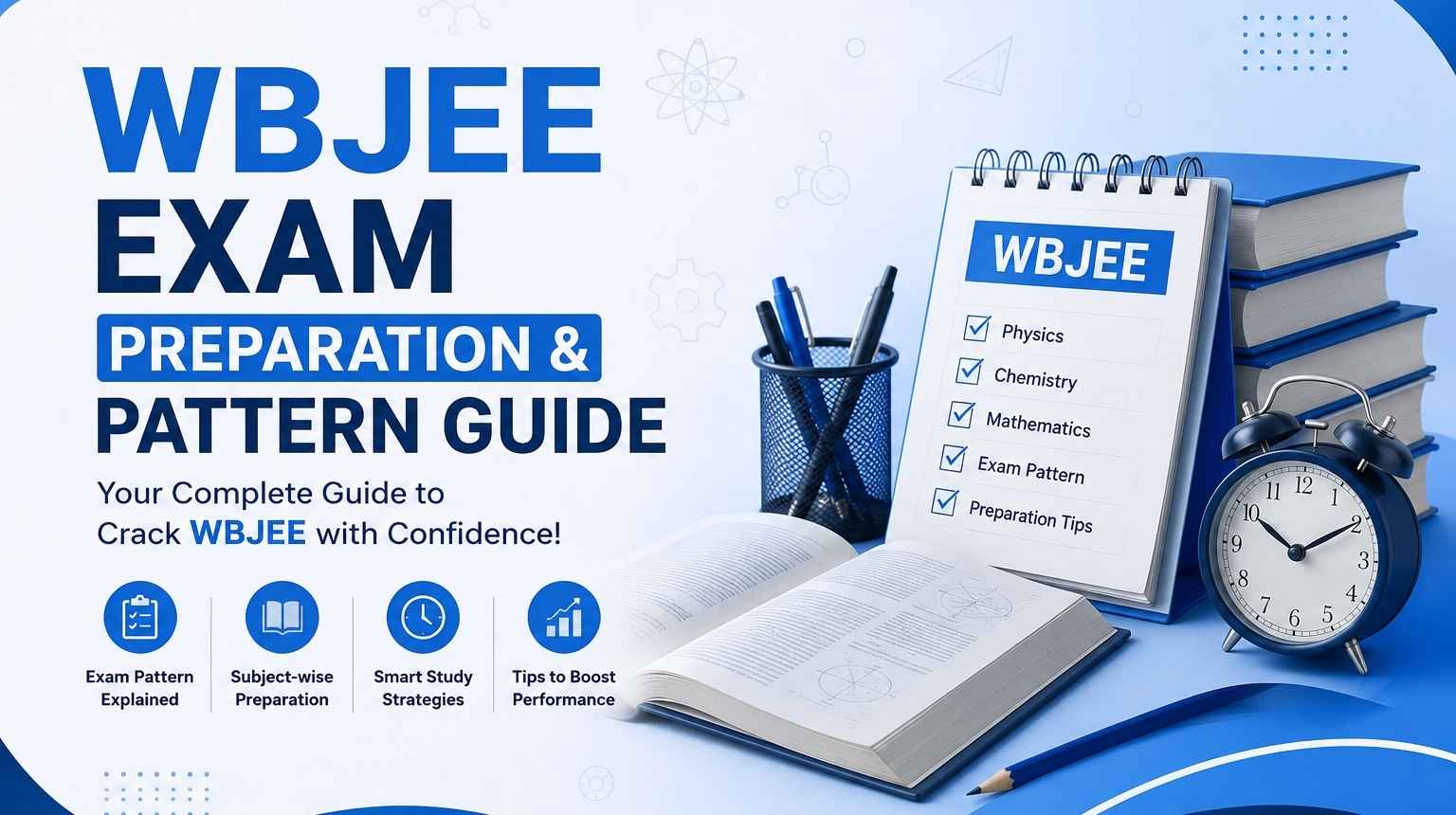
Preparing for the WBJEE is one of the most important steps for students who aspire to pursue engineering, pharmacy, or architecture in West Bengal. A well-planned strategy, consistent practice, and a clear understanding of the exam pattern can significantly improve your chances of securing a high rank. Whether you’re starting your preparation early or revising in the final months, knowing how the examination works is just as important as studying the syllabus. Understand the WBJEE Exam Pattern The West Bengal Joint Entrance Examination (WBJEE) is conducted as a pen-and-paper (offline) examination. The test consists of multiple-choice questions from three core subjects: Mathematics Physics Chemistry The examination is divided into two papers: Paper 1: Mathematics Paper 2: Physics and Chemistry Candidates seeking admission to engineering programs are required to appear for both papers. Understanding the marking scheme is essential because the exam contains different categories of questions with varying marks and negative marking patterns. Reading the instructions carefully before attempting the paper can help avoid unnecessary mistakes. Know the Syllabus Thoroughly The WBJEE syllabus is primarily based on the Class 11 and Class 12 curriculum. Students should begin by completing the entire syllabus before moving on to intensive revision. Some important topics include: Mathematics Calculus Algebra Coordinate Geometry Trigonometry Probability Physics Mechanics Electricity and Magnetism Modern Physics Optics Thermodynamics Chemistry Organic Chemistry Physical Chemistry Inorganic Chemistry Chemical Bonding Electrochemistry Instead of memorizing formulas alone, focus on understanding concepts and their practical applications. Create a Smart Study Plan A disciplined study routine can make preparation much easier. Divide your daily schedule among all three subjects while giving additional time to weaker areas. An effective preparation schedule should include: Completing new topics regularly Daily problem-solving practice Weekly revision sessions Monthly mock examinations Formula and shortcut revision Maintaining consistency is more effective than studying for long hours without proper planning. Practice Previous Year Papers One of the best ways to improve your preparation is by solving previous years’ WBJEE question papers. These papers help students understand: Frequently asked topics Difficulty level Time management Question distribution Exam pressure Attempt these papers under actual exam conditions and analyze every mistake afterward. This habit improves both speed and accuracy. Focus on Mock Tests Mock tests simulate the real examination environment. Taking regular mock tests helps reduce exam anxiety and builds confidence. After every mock test: Review incorrect answers. Identify weak chapters. Revise concepts immediately. Track your score improvement. Improve time management techniques. The objective is not just to score well but to continuously improve with each test. Effective Revision Strategy Revision is where real improvement happens. During the final weeks before the examination, avoid learning completely new topics unless necessary. Instead: Revise formulas every day. Go through important notes. Solve mixed question sets. Practice high-weightage chapters. Focus on accuracy rather than attempting everything. Short revision sessions repeated multiple times are generally more effective than one long study session. Common Mistakes to Avoid Many students lose valuable marks because of avoidable errors. Some common mistakes include: Ignoring the exam pattern Skipping revision Spending too much time on one question Not practicing enough mock tests Guessing answers despite negative marking Maintaining a calm mindset during the examination is equally important as academic preparation. Choose the Right College After WBJEE A good WBJEE rank opens doors to several reputed engineering institutions. Students should carefully compare colleges based on placement records, faculty, infrastructure, specialization, and industry exposure before making their final choice. Many aspirants also research the best BTech colleges in Kolkata to identify institutions that align with their career goals and preferred engineering branches. Professional Career Guidance & Counselling can further help students understand admission procedures, branch selection, counselling rounds, and future career opportunities, enabling them to make informed decisions after the results are declared. Final Thoughts Success in WBJEE is achieved through disciplined preparation, conceptual clarity, regular practice, and strategic revision. Rather than relying solely on last-minute study, students should focus on building a strong foundation and continuously evaluating their performance through mock tests and previous year papers. For expert admission assistance, counselling support, and personalized guidance throughout your engineering journey, Easylern Educare is here to help. To connect with our experts, call +91 8240409187 and receive professional support for your higher education planning. Frequently Asked Questions 1. How should I start preparing for the WBJEE exam? Begin by understanding the syllabus and exam pattern, then create a study schedule that covers Mathematics, Physics, and Chemistry equally. Regular revision and mock tests help strengthen concepts and improve confidence. 2. How important are previous years’ WBJEE question papers? Previous years’ papers help you understand the exam pattern, frequently asked topics, marking scheme, and difficulty level. Solving them regularly also improves speed, accuracy, and time management skills. 3. How many mock tests should I take before the WBJEE exam? Aim to take at least one mock test every week during preparation and increase the frequency before the exam. Analyzing your mistakes after each test is essential for improving your overall performance. 4. Which subjects require the most attention in WBJEE preparation? All three subjects are important, but you should spend extra time on chapters where you are weak. Maintaining a balanced preparation strategy ensures better overall scores and reduces unnecessary pressure. 5. What are the most common mistakes students make in WBJEE? Students often skip revision, ignore mock tests, spend too much time on difficult questions, and make random guesses despite negative marking. Avoiding these mistakes can improve your final score. 6. Is time management important during the WBJEE examination? Yes, effective time management allows you to attempt more questions with better accuracy. Practicing timed mock tests helps you develop the speed and confidence needed for the actual examination. 7. How can I improve my chances of getting a good WBJEE rank? Stay consistent with your studies, revise regularly, solve previous years’ papers, take mock tests, and focus on conceptual understanding instead of memorization. A disciplined approach leads to better results.
WBJEE Exam Syllabus 2026: Complete Guide for Aspiring Students
Every year, thousands of aspirants in West Bengal and neighboring regions compete in the West Bengal Joint Entrance Examination (WBJEE) to seek admission into engineering, technology, pharmacy, and architecture courses. As 2026 approaches, a solid understanding of the WBJEE 2026 syllabus becomes indispensable — it serves as your roadmap to what topics to cover, how to allocate time, and how to strategize your study. In this blog, we will dive deep into the WBJEE 2026 syllabus: the exam structure and pattern, a subject-wise breakdown of topics, weightage hints, how to use it to prepare, and tips to maximize your outcome. At the end, we also address frequently asked questions. (Note: Unless or until the official board releases changes, this syllabus is based on the latest available updates and past patterns.) Exam Overview & Pattern (WBJEE 2026) Before delving into the syllabus, it is crucial to know the exam format and how questions are structured. That shapes how you should approach the topics. What is WBJEE? WBJEE — the West Bengal Joint Entrance Examination — is a state-level competitive exam conducted by the West Bengal Joint Entrance Examinations Board (WBJEEB). It is used for admission to undergraduate courses in engineering, technology, pharmacy, and architecture in colleges in West Bengal and certain affiliated institutions. Important facts: It is an offline (pen & paper) exam, using OMR sheets for responses. The total duration is 4 hours, split as 2 hours for Paper I (Mathematics) and 2 hours for Paper II (Physics + Chemistry combined). The medium is English or Bengali (candidates may choose). Total number of questions = 155 across all subjects. Total marks = 200. Papers, Sections & Question Types WBJEE is divided into two papers: Paper I: Mathematics Paper II: Physics + Chemistry (combined in a single paper, though the questions will clearly identify subject) Each paper uses multiple choice questions (MCQs), with three categories of MCQs differentiated by marks and negative marking rules. Here is a summary of the pattern: Subject / Paper Number of Questions Marks Comment / Category Details Mathematics (Paper I) 75 questions 100 marks Combination of Category I, II, III questions Physics 40 questions 50 marks Combined in Paper II Chemistry 40 questions 50 marks Combined in Paper II Categories & negative marking: Category I questions: +1 mark for correct answer, -0.25 mark for wrong answer (1/4 negative) Category II questions: +2 marks for correct answer, -0.5 mark penalty for incorrect answer Category III questions: +2 marks for correct answer, no negative marking; these might have more than one correct option (multi-option correct Because of this variation, you must practice carefully with negative marking in mind. Also note: Candidates who appear in both Paper I and Paper II are eligible for a General Merit Rank (GMR) and Pharmacy Merit Rank (PMR). Those who appear only in Paper II get a PMR only. Aspirants for pharmacy courses may sometimes take only the Physics + Chemistry portion, depending on institution-specific rules. Syllabus Basis & Overlaps The WBJEE syllabus is largely drawn from Class 11 and Class 12 curriculum in Physics, Chemistry, and Mathematics (as prescribed by WBCHSE or equivalent board). Because of that, many topics overlap with the CBSE / State boards and even JEE Main syllabus, though the pattern, weightage, and depth may differ. A few key things to remember: No question will be asked outside the topics enumerated in the official / prescribed syllabus. There may be tricky or twist questions, but the underlying concept will be within syllabus boundaries. Because the syllabus (for many years) remains stable, past years’ papers are powerful tools for predicting which subtopics get more focus. WBJEE 2026 Syllabus: Subject-Wise Detailed Topics In this section, we break down each subject (Physics, Chemistry, Mathematics) into its constituent chapters and subtopics, with suggested emphasis based on past trends. Physics Syllabus 2026 According to sources, the WBJEE Physics syllabus has 22 chapters covering a broad range of topics in mechanics, thermodynamics, electromagnetism, optics, modern physics, etc. Below is a representative list (with subtopics) that aspirants need to master: Physical World, Measurements, Units & Dimensions Fundamental & derived units, dimensional analysis Significant figures, error & uncertainty Kinematics Motion in one and two dimensions Velocity, acceleration, displacement, trajectories Laws of Motion Newton’s laws, force, momentum, impulse Friction, equilibrium The Motion of the Centre of Mass, Connected Systems, Friction Systems of particles, center of mass, motion under internal & external forces Pulley, string, connected bodies Gravitation Universal law of gravitation, gravitational potential, acceleration Orbits, escape velocity Bulk Properties of Matter Elasticity, stress, strain, Hooke’s law Pressure in fluids, Pascal’s principle Viscosity Viscous forces, terminal velocity, Stoke’s law Thermodynamics Zeroth, First, Second law Heat, work, internal energy, entropy Kinetic Theory of Gases Gas laws, Boltzmann constant, molecular speeds distributions Oscillations & Waves Simple harmonic motion Wave motion, superposition, sound Electrostatics Coulomb’s law, electric field, potential, Gauss’s law Current Electricity Ohm’s law, circuits, resistors, series/parallel Magnetic Effects of Current Biot–Savart law, Ampere’s law, magnetic fields in conductors Magnetism Magnetic properties of materials, hysteresis Electromagnetic Induction & Alternating Current Faraday’s law, Lenz’s law, induced EMF AC circuits, RMS values Electromagnetic Waves Wave propagation, spectrum Optics I (Ray Optics) Reflection, refraction, lenses, mirrors, optical instruments Optics II (Wave Optics) Interference, diffraction, polarization Particle Nature of Light & Wave-Particle Dualism Photoelectric effect, photons, de Broglie waves Atomic Physics Atomic models (Bohr), energy levels Nuclear Physics Radioactivity, nuclear reactions, decay Solid State & Electronics Semiconductors, band theory, diode, transistor basics This set of topics broadly matches what many exam preparation sites list. Emphasis / High-Weight Topics: Based on analysis of past years, the following tend to appear more often: Laws of Motion & Kinematics Gravitation Thermodynamics & Kinetic Theory Current Electricity & Electromagnetism Optics (especially ray optics) Modern Physics (atomic, nuclear) Thus, while covering everything, allocate extra time to these areas. Chemistry Syllabus 2026 The Chemistry syllabus in WBJEE 2026 is reported to consist of 27 chapters spanning physical, inorganic, and organic chemistry. Below is a comprehensive breakdown of topics: A. Physical …
Continue reading “WBJEE Exam Syllabus 2026: Complete Guide for Aspiring Students”