
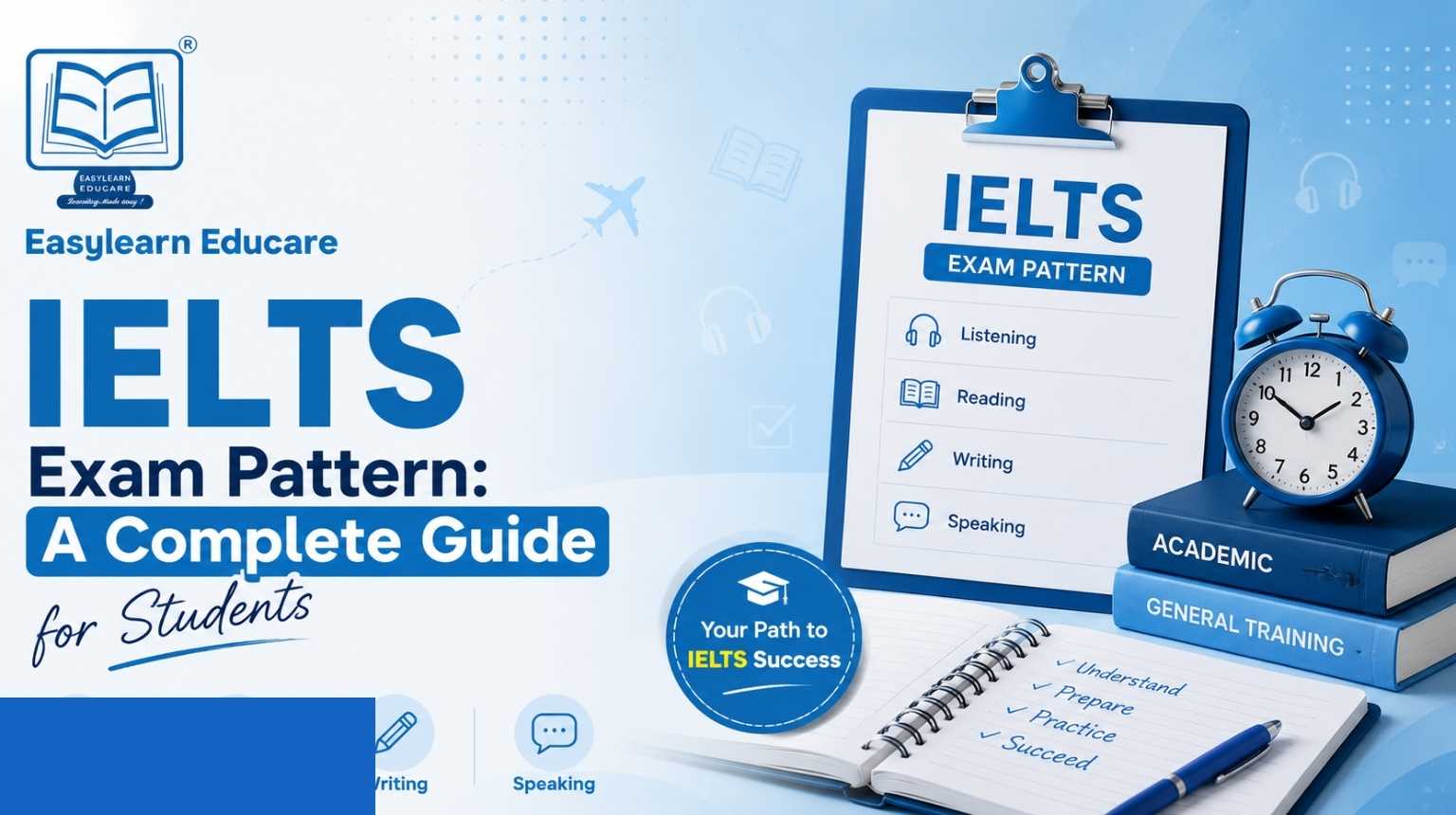
The International English Language Testing System (IELTS) is one of the most recognized English proficiency exams in the world. Every year, millions of students and professionals appear for the test to study, work, or migrate abroad. Understanding the IELTS exam pattern is the first and most important step toward achieving a high band score.
Whether you are planning to study in countries like the UK, Canada, Australia, or New Zealand, knowing the structure of the IELTS exam can help you prepare effectively and confidently.
What is the IELTS Exam?
IELTS is designed to evaluate a candidate’s English language skills in four key areas:
- Listening
- Reading
- Writing
- Speaking
The exam is jointly managed by the British Council, IDP: IELTS Australia, and Cambridge Assessment English. It is accepted by thousands of universities, employers, and immigration authorities worldwide.
Students seeking professional guidance for overseas education often consult institutes like Easylern Educare for proper preparation strategies and counselling support.
Types of IELTS Exams
There are two major types of IELTS tests:
1. IELTS Academic
This version is for students who wish to pursue higher education abroad or apply for professional registration.
2. IELTS General Training
This version is suitable for migration, work experience, or secondary education in English-speaking countries.
Both test formats have the same Listening and Speaking sections, but the Reading and Writing sections differ slightly.
IELTS Exam Pattern Overview
The IELTS exam is divided into four sections. The total duration of the exam is approximately 2 hours and 45 minutes.
| Section | Duration | Number of Questions |
|---|---|---|
| Listening | 30 Minutes | 40 Questions |
| Reading | 60 Minutes | 40 Questions |
| Writing | 60 Minutes | 2 Tasks |
| Speaking | 11–14 Minutes | Face-to-face Interview |
Let’s understand each section in detail.
IELTS Listening Section
The Listening test lasts for 30 minutes and consists of four recorded audio clips. Candidates must answer 40 questions based on these recordings.
Format of the Listening Test
- Part 1: Conversation between two people
- Part 2: Monologue on an everyday topic
- Part 3: Academic discussion among multiple speakers
- Part 4: Academic lecture or talk
Important Tips
- Listen carefully to instructions
- Practice note-taking
- Focus on spelling and grammar
- Improve concentration while listening
Regular practice with mock tests can significantly improve listening skills.
IELTS Reading Section
The Reading section is 60 minutes long and contains 40 questions.
IELTS Academic Reading
Includes passages from books, journals, newspapers, and academic texts.
IELTS General Reading
Contains everyday materials such as advertisements, notices, company handbooks, and articles.
Types of Questions
- Multiple choice
- Matching headings
- True/False/Not Given
- Sentence completion
- Summary completion
Preparation Tips
- Improve reading speed
- Learn skimming and scanning techniques
- Practice vocabulary daily
- Manage time effectively
Many students struggle with time management in this section, so regular practice is essential.
IELTS Writing Section
The Writing section also lasts 60 minutes and consists of two tasks.
IELTS Academic Writing
- Task 1: Describe graphs, charts, or diagrams
- Task 2: Write an essay on a given topic
IELTS General Writing
- Task 1: Write a letter
- Task 2: Essay writing
Scoring Criteria
Examiners evaluate:
- Task achievement
- Grammar accuracy
- Vocabulary usage
- Coherence and cohesion
Tips for Better Writing Scores
- Practice essay structures
- Use formal language
- Avoid grammatical errors
- Develop ideas clearly
Professional mentoring from the best education consultancy in Kolkata can help students improve writing techniques and overall exam confidence.
IELTS Speaking Section
The Speaking test is conducted face-to-face with an examiner and lasts between 11 to 14 minutes.
Parts of the Speaking Test
Part 1: Introduction and Interview
Questions about personal life, hobbies, studies, and interests.
Part 2: Cue Card
Candidates receive a topic and get one minute to prepare before speaking for two minutes.
Part 3: Discussion
A deeper discussion related to the cue card topic.
Tips to Score Well in Speaking
- Speak confidently and naturally
- Avoid memorized answers
- Improve pronunciation
- Expand answers with examples
The speaking test evaluates fluency, grammar, pronunciation, and vocabulary.
IELTS Band Score System
IELTS scores are measured on a band scale from 0 to 9.
| Band Score | Skill Level |
|---|---|
| 9 | Expert User |
| 8 | Very Good User |
| 7 | Good User |
| 6 | Competent User |
| 5 | Modest User |
Most universities abroad require a minimum score between 6.0 and 7.5, depending on the course and institution.
Computer-Based vs Paper-Based IELTS
Students can choose between:
- Computer-delivered IELTS
- Paper-based IELTS
Both formats have the same difficulty level, question types, and scoring system. The Speaking test remains face-to-face in both formats.
Which One Should You Choose?
- Choose computer-based if you type faster
- Choose paper-based if you prefer writing by hand
Selecting the right format depends on your comfort level.
Common Mistakes Students Should Avoid
Many candidates lose marks due to avoidable errors, such as:
- Poor time management
- Lack of vocabulary
- Ignoring instructions
- Writing incomplete answers
- Speaking too little
Consistent preparation and expert guidance can help students overcome these challenges effectively.
Final Thoughts
Understanding the IELTS exam pattern is essential for achieving a good band score. Each section tests specific language abilities, and success depends on regular practice, smart strategies, and confidence.
Students planning to study abroad should start their preparation early and seek professional support whenever needed. Easylern Educare provides students with proper guidance, preparation support, and the best Career Guidance & Counselling to help them achieve their international education goals.
With the right preparation plan and dedication, scoring high in IELTS becomes much easier.